

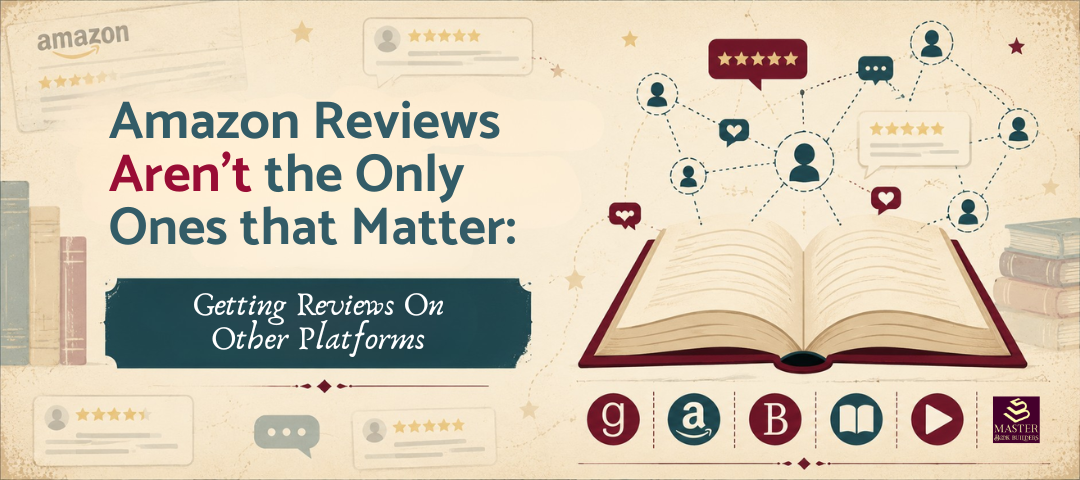
Amazon Reviews Aren’t the Only Ones That Matter: Getting Reviews on Other Platforms
Let’s talk about building credibility beyond the world’s largest bookstore.
Yes, Amazon is the largest bookstore in the world. Any new author knows or has been told, “Get more Amazon reviews.” The prevailing number is at least 50, to keep Amazon’s bot interested in your book.
It’s good advice. You do need Amazon reviews. (Remember, never ask for a ‘good’ review – not on Amazon or anywhere else. Just ask for an honest review, and try to learn from each one.)
Reviews do influence buyers and provide more visibility. There’s no denying that. They also provide social proof.
But somewhere along the way, we all began believing something that just isn’t true:
That Amazon is the only place where reviews matter.
I’ve been doing this a long time. More than 20 years (holy cannoli!), and I, too, bought into and promoted the ‘get Amazon reviews’ advice for a long time.
But what if…there is a different perspective?
What if your goal wasn’t to collect Amazon reviews?
What if it was to build credibility?
Those are two different things, aren’t they?
Which one is more important? Credibility. By far. Credibility and visibility.
So, how do you do that…beyond Amazon? By understanding this:

Amazon is ONE Place to Build Credibility and Gain Visibility. It’s not your entire audience.
Here’s a simple question: where do people discover books?
Sure, Amazon is up at the top. But where else do folks find out about new books (and some formerly new books)?
🤓 podcasts
🤓 newsletters
🤓 libraries
🤓 bookstores (B&N and independent bookstores)
🤓 book clubs
🤓 conferences
🤓 LinkedIn – FB – Instagram – TikTok
🤓 Substack
🤓 YouTube
🤓 Goodreads
🤓 Word of mouth
🤓 Friends and colleagues
So, Amazon is one discovery tool. It’s not the only discovery tool.
Nonfiction Books and Discoverability
Consider this: someone, a keynote speaker, at a conference, is talking about their experiences doing this or that. They have a book. But, in their speech, they recommend other books. Books that influenced their focus in life.
Or someone recommends a podcast to you and others, and in the podcast, there are authors talking about their work and their books.
Someone reads a newsletter, like this one. And sees me recommend not just my clients’ books but books like Mastering Short Form Video Content by Annette Richmond.
These are just a few ways books get noticed. Masterminds. LinkedIn discussions. Blogs.
All of this proves that you need to think beyond Amazon when you’re considering book reviews for your book. These are people who might never write an Amazon review. But they’ll talk about the book that changed their life or how they look at life.
Good Reviews Do Several Things
When I say good, I don’t mean a ‘good review’ of your book. I mean a review that’s thoughtful and worthy of other people’s time.
Like restaurant reviews. No one starts with, “They got 4.5 stars on Yelp.”
Instead, they say, “You have to try the pasta alfredo! And the bread. The bread is to die for!” Okay, that part about the bread might be Tom and me. At a local restaurant. We did say that.
You feel the excitement and honest recommendation in the story the person tells.
You believe it.
You decide to check out that restaurant.
That 5-star rating is nice, but it doesn’t compare to an actual experience from someone you know and trust.
All authors crave this kind of review. How the book changed the reader. How the book influenced the reader. How the book moved the reader!
Reviews are meant to show other people how great something is, which is a recommendation for others to try it out, whatever it is. We’re not going to cover bad reviews today. My take on bad reviews is to learn what you can from them and move on.
Every one of the bullet points above is a way you can grab some visibility and credibility. We’ve discussed most of them here, in blog posts. Check them out.
Now to the nitty-gritty. Here’s how you don’t let A own every conversation about your book.
Where else can you get reviews, other than that largest bookstore in the world?
- The StoryGraph – an Independent Alternative
I knew nothing of The StoryGraph until someone, my good friend Karen Loomis, DM’d me on LinkedIn and asked where she could go to get reviews of her book They Didn’t Tell Me I Was Black, out in September. She wasn’t fond of just using A.
I was stumped. I asked myself, Are there any other places to get reviews, other than you know where?
The StoryGraph popped up in a Google search, and I checked it out. It’s an Independent reading platform that allows readers to review books, rate them, describe their experience with the book, and recommend books to others.
StoryGraph encourages reader to find books that match their interests. It’s not out to sell, sell, sell, like A.
Readers can actually share their thoughts about the book. You, the author, can learn from these reviews without worrying about that 5-star rating you thought was so important.
p.s. They have good customer service, also. I emailed to ask how to add books to the database, and they answered the next day. Here’s the link they provided.
- BookBub – Not Just for Book Deals
Yes, BookBub does great email campaigns. I know several authors who have used BookBub to increase visibility of their book. To great results. Yes, there is a fee involved, but you’re paying for the work and the network of readers on BookBub.
However, did you also know that readers can:
👉🏼 follow authors
👉🏼 discover new books
👉🏼 leave ratings
👉🏼 write reviews
It can’t hurt to introduce BookBub to your readers. And to become more familiar with it yourself.
- LibraryThing – this was brand new to me!
I was pleasantly surprised to discover this. And to find out it’s been serving readers, librarians, and educators for years.
It looks like a small community compared to A. But sometimes small is better. Better conversations – thoughtful and detailed. About your book, perhaps.
I think this is a great place to be noticed if your book really challenges people’s thinking. Or is inspirational. Or is bringing new ways to think about old problems. Or is just plain entertaining.
It never hurts to get libraries and librarians interested in your book.

- Goodreads…yes, yes, it’s part of A, but hear me out
Just as Barnes & Noble stores are managed by whoever owns the store, which allows them to host independent local authors, if they choose, Goodreads is owned by A but operates in a totally different way.
Authors seem to be avoiding or ignoring Goodreads because they are less than appreciative of A. That’s wrong-headed thinking.
A lot of readers gather on Goodreads to write reviews and share recommendations.
There are entire communities built around individual books and the authors of those books.
From my visit there recently, and the fact that I have an author page there, I recognized that Goodreads is a place where some people go to decide what to read, even before they decide where to buy.
Make this work for you. Forget that it’s part of A. Many of your readers are there. Stop in and say hi.
- What about your own website?
First of all, you have to have a website. You do, don’t you? You’ve followed Tom’s 7 Essentials of Author Websites, yes?
Ok. That’s good.
Now I want you to create a page on that website where readers share:
📖 what they learned from your book
📖 how your book helped them
📖 what changed in their lives after reading it
📖 a recommendation to tell a friend about it
📖 why they picked it up to read
📖 almost anything else on their mind about your book (within reason – you will monitor and delete off-topic posts)
This can be on a page (blog) that lets people communicate directly with you. Having live conversations, right there, on your website. This is generally a blog, but instead of you adding content on a daily or weekly basis, the page can be a place readers can connect with you and each other. Real conversations that inspire loyalty.
One way to protect yourself from spammers is to only publish relevant comments. Most blogs come with this feature. I always tell people, your blog is your personal living room. You’re inviting the rest of us in as guests. It’s your choice to block us or ask us to leave.
If you can do this, you will generate a powerful library of comments and testimonials.
It is your choice where to display them. On your homepage. In your media kit. In a newsletter. On social. In the front matter of your next book. (I like the last one – in your next book!)
How much more persuasive is this – compared to some rating on A where you can’t communicate with the reviewer?
- Don’t Ignore Book Clubs! (Read my post about them here)
Too often writers either dismiss book clubs or feel that it’s too hard to be featured in book clubs.
Just today someone on LinkedIn who runs a book club reached out to me to invite me to offer book suggestions. This person clearly knows me from my consistent LinkedIn writing and will be a powerful ally going forward.
When you consider the power of the conversations that book club members have, book clubs become a must-have for any published author.
Whether the book club has 5 members or 55 members, the conversations – which turn into recommendations – are priceless! This is how you create advocates not only for your writing, but for you! Once people become attached to you, they will help promote everything you do. Just ask Taylor Swift.
Speaking of Taylor Swift, read Tom’s post about The Math for Monetizing Your Book, where he shows you how a small group of fans can produce big results.
Also, book club members often have blogs. Where they write great reviews and recommendations. When you participate, the content is more priceless than gold.
- The Untapped Gold Mine Called LinkedIn
Most of our authors’ books are nonfiction, of one sort or another. But don’t discount LinkedIn for fiction. If you’re a consistent contributor to LinkedIn and you write fiction, remember that those of us who are professionals on LinkedIn, mainly for that reason, still read fiction on our time off.
If you’re in the coaching, leadership, professional development, nutrition, health, mental health, or inspirational business, you should be on LinkedIn. And as such, consider it another place to get a solid review.
No, people aren’t going to write full book reviews- well, Kat Shaw does, but she’s special- her work is unparalleled – but they will write short, focused, purposeful reviews you can use in your marketing and on your website.
You have to take that first step, though. You have to give them a reason to write about your book. Sometimes, as my friend Karen Loomis does, you might highlight them for supporting your publishing journey. They, in turn, may then write a review on their feed for you. Her book, Nobody Told Me I Am Black, touched me not only because I know Karen, but I trust her authenticity. In her description, she writes:
“Book One does not ease you in. Chapter One, The Race Card, punches you in the nose. You either continue or stop. There is no gradual entry.
“The chapter begins with race and with the meaning of racism. Not as abstraction, but as structure.”
Since this is a topic I know I need to learn more about, I have been supporting Karen on LI for months now. And I cannot wait to get my early purchase copy – perhaps this week!
Authors promote the “just published” info about their book all the time on LI. I wonder if these folks are reaching out to their personal networks to also politely ask for a review. Writing a personal DM and asking folks to support the book by writing a review is no different than one friend reaching out to another to ask for a little favor (if they’ve read it – if not, a personal note to invite them to check it out can be in order).

Here are some questions you can ask on LinkedIn to inspire folks to talk about your book:
❓ What idea from the book most resonated with you?
❓ Where in the book did you see yourself?
❓ How did the book change the way you think about (x,y,z)?
❓ Will you implement the ideas from Chapter X?
When you consider that one thoughtful LinkedIn post could reach hundreds, and inspire conversations that will exist forever, you begin to understand the power of LinkedIn as a place to get reviews.
In the end, the goal is to have conversations with your readers. You can’t do that on A. Reviews on A are all well and good; I don’t want you to ignore them. People who are kind enough to write them deserve your appreciation. However, other than Stacy from the Burbs, you never get to know those people.
If you look at reviews as a way to generate conversations, as all of the ideas here are meant to do, the true purpose of reviews becomes clearer. To get to know your readers.
✒️ Amazon reviews
✒️ The StoryGraph
✒️ BookBub
✒️ Goodreads
✒️ Your website
✒️ Book Clubs
✒️LinkedIn
All of these ideas, these places to get reviews (including A), are to generate conversations. Don’t chase stardom. Don’t settle for just A. Don’t ignore the folks in these groups who are open to learning more about you and your book.
Be accessible. And don’t forget to ask, “Who else do you know who would benefit from reading this book?”
Chat gave me some ideas for writing this post – but I wrote the post – and it did propose the following, which I could have rewritten, but it’s fine as is, so here goes:
“Your author platform is larger than one retailer. Your reputation is larger than one algorithm.”
Think beyond the big A. Think about generating the like and trust factor. Your action steps this week are to explore one or two of these suggestions and see where it takes you.
Give us a hint in the comments about which one(s) you’ll explore and why.
As usual, connect with me on LinkedIn.



Leave a Reply