

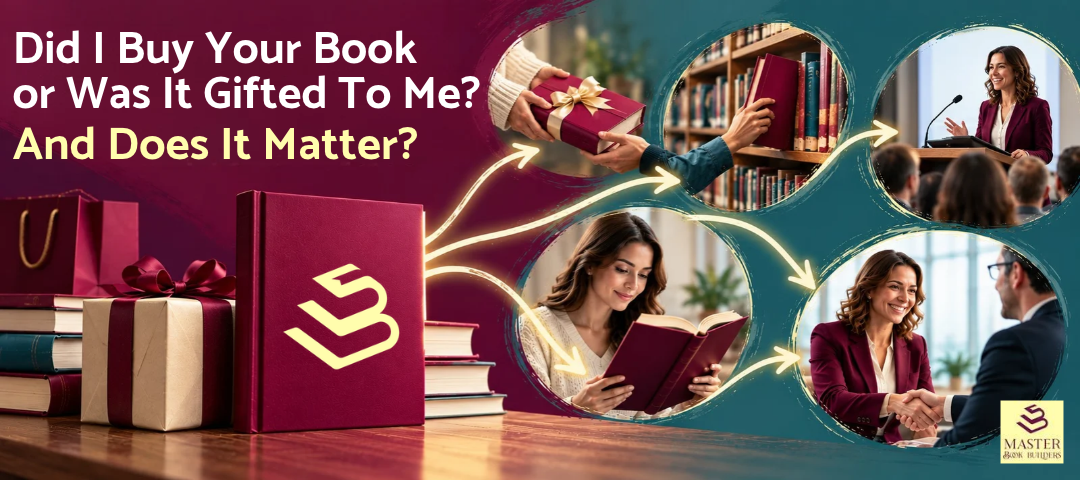
Did I Buy Your Book or Was It Gifted To Me? And Does It Matter?
Most people, and I’ll go so far as to say 99% of the people, who write books do so because they want other people to read them. They’re not navel-gazing, as we talked about in my last blog post a couple of weeks ago, titled “AI vs The Editor.” Their books have a purpose. One of those purposes is to attract readers.
That’s always our lofty goal, isn’t it? People ask me, “How many people do you think will read my book?”
I have no answer. My crystal ball broke years ago.

Instead of worrying about readers, though, let’s look at this from a different angle. As a smart person once said (maybe it was me, maybe it was someone else, but… it’s me now):
Books don’t make money. Businesses do.
If your book is a business, as I’ve always suggested it should be, you might stop worrying about readers and start thinking about ROI in the form of the business of being a writer.
Not to Diss Readers Entirely…
Despite news to the contrary, people still read books. According to Publishers Weekly, in 2025, the numbers for independently published books and books published by traditional publishers rose (38.7% for indie, 6.6% for trad). Let’s focus on indie authors, as that’s where Master Book Builders sits – offering services to indie authors.
Looking at registered ISBNs, we see that in 2024, 2.5 million were bought independently. In 2025, that number rose substantially to 3.5 million (note: each type of book gets its own ISBN, so one author could buy dozens of ISBNs for their print books, audiobooks, and digital books; therefore, we can’t extrapolate how many of the ISBNs went to individual authors). Regardless of how many ISBNs were purchased by one individual or hundreds of individuals, the numbers show growth.
To try to see what those numbers mean in relation to readership, let’s look at a 2025 Pew Research Center report in which people were asked if they read and how much. In 2025, the results showed that 75% of adults read all or part of a book. Some read as many as 21 books. Tom will tell you that print sells better than digital or audio, and the Pew Research Center study supports that. Hail the almighty print book!
So yes, people still read. Readers count for something. In fact, let me share a particular statistic from the Pew report that always makes me smile: “Women are more likely than men to say they’ve read a book in the past 12 months.” This statement has been standing true for decades.
Okay, people read. How does that translate into buyers for your book?
The Authors Guild tells us that royalty payments to authors are not keeping pace with reading. Why? Because people might obtain books from friends, libraries, or other ‘free’ sources (they didn’t mention any of the free sources, and I don’t care to, either, other than to mention used bookstores, which yield no royalties but still play a part in getting authors noticed). ).
Interestingly,
“The shift from purchases to low or non-royalty generating channels has profound implications for the writing profession. According to the Authors Guild’s last income survey in 2023, the median income of a full-time author from their books is $10,000 a year, and $20,000 from all writing-related work combined. This is down roughly 42 percent since 2009 when the first consumer Kindles entered the marketplace.”
I expect you’re sighing heavily now. You’re thinking, Why bother? Sure, people might read my book, but if they get it free somehow, how does that benefit me? My royalty payments will suffer.
Before going on, let me remind you that at Master Book Builders, our clientele is mostly nonfiction business books. We do some memoir and fiction (one of our most successful authors is a fiction author), and while my post today is aimed at my business professionals who want to write a book, fiction authors can easily modify it for their own purposes.
Do not despair! Do not think that my lending your book to a friend, or having someone find it at the library, isn’t worthwhile. Royalty payments should not be the only measure of your success with your book. Authors have for too long been misled into believing that sales of their book – generating royalties – should be their focus. Yes, I’ve even offered advice on where and how to generate sales, but it’s time to look at the forest, not the trees.
Using your book to build your business and serve more clients turns it into a profit-making machine! As Tom says in this post, 3 Lessons from Football Star A. J. Brown,
“You are not there to sell your book;
“Your book is there to sell you.”

Let’s go back to our favorite analogy: Book as Business card.
The reason we believe in the concept of book as business card is because we believe you have a unique opportunity non-authors don’t have. By putting your book to work for you, by using it as a way to get in front of policymakers and executives, marketing managers, or anyone else important in your quest to build your business, you’re thinking ahead to outcomes that go beyond royalty payments.
People don’t need to buy your book to benefit from it. And you don’t need to sell your book to benefit from it. You need to think of it as a means to an end, instead of the end itself. In fact, when you look at it as a business card, as something you might give away to impress someone you’ve just met at a networking group or conference, you’re offering a way for people to get to know you better the moment they open the book and read your dedication and introduction.
Yes, it matters to whom the book is dedicated. If you dedicate it to your cat, that’s one message. If you dedicate it to your wife, that’s another message. If you dedicate it to the people reading it, that’s another message entirely. All of those say something about you.
A book will outlast a business card. A book proves you have something to say, and you are confident enough to say it out loud. A book makes everyone stop and say, “Wow. You wrote a book.” All the while, they’re thinking, “That’s impressive.” Because they will never write a book (or, you may inspire them to write one!).
Here are 12 Easy Ways to Stop Worrying about “Selling Your Book”
(and instead, learn how to use it in a variety of ways that don’t always include ‘selling’):
A book gives you credence. Authority. It makes you a thought leader. You may be familiar with some or all of these authors who do just that:
- Adam Grant: Think Again (2021) Organizational psychology.
- Dorie Clark: The Long Game (2021) Professional reinvention.
- Sherry Turkle: Reclaiming Conversations (2015) How to talk in a digital world.
- Mel Robbins: The Let Them Theory (2024) Motivational speaker in personal development.
- Bryan Eisenberg with Jeffrey Eisenberg: I Think I Swallowed an Elephant (2025) Stories to build success.
Each one of these authors understands the power of their book to showcase their credibility and attract attention. I beta-read Byan Eisenberg’s book, and I highly recommend it for your October reading.
Need an even bigger list? How about all of these authors – many of whom are more famous for their work than their books.

A book gives people a reason to trust you.
It’s hard not to take an author at face value. In the minds of readers, whether or not they purchased the book or came by it some other way, they credit the author with an immediate degree of trust and authority.
A book makes you stand out from your competitors.
You hear this from me and others in the book world, but most people want to write a book and never do. Professionals who take the time and put in the effort to finish their books stand out from their competition like a bright red flag saying, “Look at this. I did it. Just for you.”
A book opens doors to podcasts and other speaking opportunities.
Yes, sometimes you have to find them on your own, but that’s part of your due diligence as an author. Your AI can help you with that.
A book gives you something to talk about for weeks and months.
You can take stories from the book or elaborate on stories you didn’t share completely. You should definitely talk about why you wrote the book and how it can serve the audience you’re sharing it with.
A book can generate conversations at events or in online forums.
It can even offer content for your LinkedIn posts – as you share insightful parts of the book to the people who read your posts or find you via someone else’s comments. Whether they buy the book or not, they are more likely to believe what you say because of the book.
A book proves you talk the talk and walk the walk.
You can’t deny what’s written on the page in your book. Your content there – especially the stories you tell – proves to readers that you’re serious about your philosophy and your work. And if you’ve done well with the writing, they are engaged and want to further the conversation after they finish reading.
A book helps support workshops and webinars.
We’ve talked about these before. Webinars and workshops are excellent ways to tap into the power of your book. Visit this blog post from 2023, where I talked about other “Money-Making Opportunities from Your Published Book.”
A book helps you reconnect with former clients and even reintroduce you to clients you haven’t connected with in quite some time.
A book gives you a foundation to create new services.
You can use this idea to create a call to action in the book, asking readers what services they would like you to create on their behalf based on what they read.
A book is an introduction to event planners, possible new clients, and other authors with whom you might collaborate on book signings or other events.
A book even helps you learn new things about yourself.
Most of our clients tell us this has been true for them after their book is published. Writing, publishing, and promoting their books uncovered new creative sides of themselves they weren’t aware of before. When you talk about this in blog posts or on LinkedIn, people stop and listen. It makes you human. And we’re all desperate for human interaction these days. Aren’t we?

The goal of this post was to show that the person who takes your book out of the library might become your next big client. Even though she did not buy your book.
The person who was gifted the book will surely want to connect, as books are given as gifts for a reason. Usually, in the case of nonfiction books, to help the reader learn something important. That person may want to learn more about you and explore how to work with you after reading that ‘free’ book.
The person who sees you on LinkedIn and comments on your content may not buy the book, but having heard you talk about it a good bit, they may decide they need to connect and have a face-to-face on Zoom. This could lead to many valuable meetings in the future.
Sales are only one way to judge the value of something. A product. An idea. A book.
Like any product, your book will return the rewards you expect if you give it the attention it deserves. The authors mentioned earlier didn’t write, publish, and sit back waiting for their royalty statement. In fact, all of them realized their book was a starting point even as they wrote it. They grew their businesses by using the book as an introduction or a way to gain bigger and better speaking engagements.
If we look at a book’s lasting value, it’s easy to see why you can’t measure your success as an author only by how many sales you’ve made this month. Or this year. Books outlast business cards and generate more interest than a website.
Fiction authors, all of this applies to you. Readers (library, gifted, other free sources) still want to get to know you. The more you can connect with them in the various ways shown here, the more likely they are to BUY your next book.
What will you do with your book this year?
Don’t forget to connect on LinkedIn. My posts there are condensed, given LinkedIn’s restrictions, but I still share the ins and outs of writing, publishing, and marketing a book several times a week.


Leave a Reply