

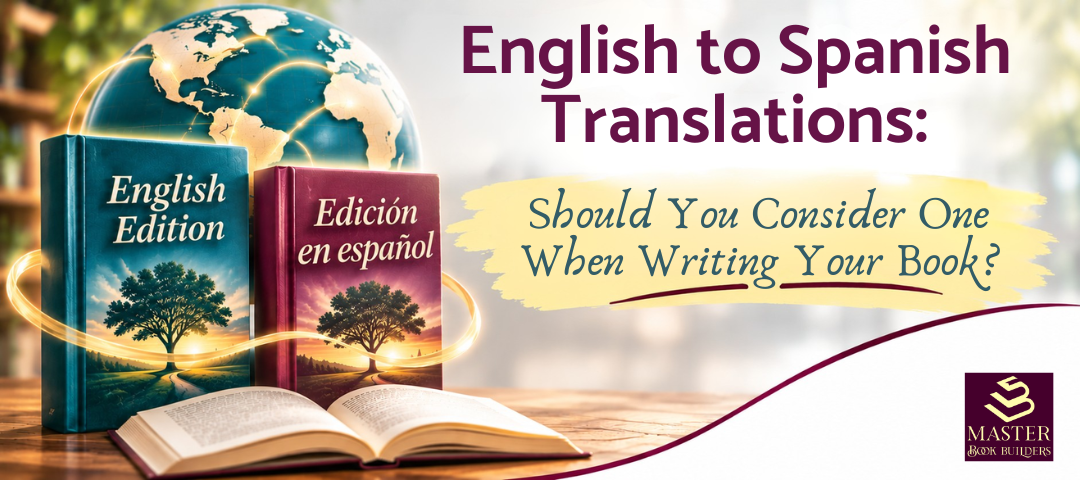
English to Spanish Translations: Should You Consider One When Writing Your Book?
This is for all authors, but especially for those who recognize that while English is the dominant language on the planet (including English as a second language), it is not the only language they should offer their books in.
For anyone who has considered another language edition of their book, Spanish is the logical choice as it ranks a close third, after English and Mandarin Chinese, according to Ethnologue. Whether or not Mandarin Chinese is a language to consider is a post for another day, perhaps. For today, we’ll focus on Spanish.
Recently, I had the chance to talk to someone whose business is helping authors take their books, of any genre, from English to Spanish. We had a great conversation about what that means. And it goes far beyond the word-for-word translation we often think of as having our work offered to another culture.
That’s the big deal here: Culture
My friend, Maria Borden, “Cross-Cultural Narrative Coach | Bilingual Narrative Specialist | Writer,” is interviewed later on in this post and reveals what it really means to offer your work in another language. In Spanish, which is her purview. From her research at Bookwire, which shows the Spanish-language ebook market grew 1.5% in revenue in 2025, Maria showed me that the Spanish-language book market isn’t just one audience. It includes different reading cultures from Spain, Mexico, Colombia, Argentina, Chile, Peru, Central America, and the U.S. Spanish-speaking population.
Each region has its own emotional reading patterns, distribution systems, pricing realities, and bookstore traditions. Understanding these differences is essential for any author preparing a Spanish Edition, because the success of a translated book depends not only on the quality of the translation but on how well the edition aligns with the cultural expectations of its intended readers.
Maria told me,
“In the studio, we teach that a Spanish Edition is not a mechanical transfer of words; it is an extended asset of the English version, a narrative expansion that requires emotional awareness, cultural nuance, and intentional co-creation. Traditional translation is usually viewed as one step, but it is really a mix of many parts that are not fully discussed—story movements, cultural changes, keeping the author’s voice, and their identity across languages. This is why the first step in creating a Spanish Edition is not translation but cross-cultural awareness, the foundation that allows a story to travel into new cultures without losing its essence.”
Maria also pointed me toward what has long been known as the “Three Percent” problem in U.S. publishing. The University of Rochester’s Three Percent project took its name from the oft-cited statistic that only about 3% of books published in the United States are works in translation. Its Translation Database was created to track literary works entering the U.S. in translation, offering another way to see just how narrow that pathway can be.
These resources help authors understand the power of considering a Spanish edition for their books.
Here’s an important point she made during our interview:
“By contrast, Spanish‑language books translated into English in the United States accounted for only 79 fiction and poetry titles that same year, according to the University of Rochester Translation Database. When viewed side by side, the gap becomes unmistakable: English to Spanish is a commercial pipeline, while Spanish to English is a selective literary pathway.”
What does this mean for our indie authors? It’s clear: a Spanish Edition is not simply a translation—it is a second market, a second audience, and a second revenue stream.

Here’s something interesting I hadn’t thought of when considering an English to Spanish translation:
“Distribution adds another layer of complexity. A Spain-market edition can be sold in Mexico, Colombia, Argentina, Chile, Peru, and the U.S. Spanish‑speaking market without being linguistically adapted for those readers. Retail availability does not guarantee cultural alignment. A book can be accurately translated, professionally edited, assigned an ISBN, and uploaded to major retailers—and still remain commercially invisible. Discoverability depends on metadata, categories, pricing, retailer placement, territory settings, and cultural resonance. This is why translation alone is insufficient; a Spanish Edition must be built with a clear understanding of its target markets.”
After speaking with Maria more than once, I began to understand her extensive knowledge, and I felt it was my duty to interview her for our newsletter. Read fully and access information on connecting with Maria at the end.
Stories are bridges. Helping authors cross that bridge with Maria Borden.
1. Why would an author want a Spanish translation?
An author shouldn’t just want a Spanish translation — they should want to build a cultural asset.
In my studio, a Spanish Edition isn’t a translation project –
— it’s an extension of the author’s intellectual property — a continuation of the same story, carried with the same intention, the same emotional integrity, and the same level of protection, just expressed in another language.
Most authors tell me they’ve never even considered creating a Spanish Edition. Not because they don’t want one, but because the industry has conditioned them to believe there is only one publishing lane. They pour love, care, and protection into their English Edition… and then assume a Spanish Edition is something they simply “hand off” and hope comes back intact.
I have to wonder – why would an author give their English Edition so much attention, craft, and protection — only to throw their Spanish Edition into the pack of wolves without the same care?
Your Spanish Edition should not be a lesser version of your English Edition.
It should be an extension of it — a cultural asset that expands your reach, your message, and your legacy.
And here’s what most authors don’t know:
- Transcreation — preserving the emotional heartbeat
- Spanish adaptation — shaping the story for Spanish-dominant readers
- Localization — adjusting tone, rhythm, and cultural references
- Dual-language Editions — English on one side, Spanish on the other
A Spanish Edition gives your story:
➡️ a second market
➡️ a second audience
➡️ a second revenue stream
➡️ a second cultural identity
➡️ a second life
It’s not a translation. It’s not a copy. It’s not a separate book. It’s a cultural asset — an intentional extension of the story you already built with so much care.

2. Is this more for fiction or nonfiction? How do they vary?
My studio isn’t limited to fiction or nonfiction — both can become powerful cultural assets.
The real deciding factor isn’t genre. It’s how the story needs to move across cultures.
Fiction carries emotion, rhythm, humor, tension, and character voice. Nonfiction carries clarity, structure, and conceptual meaning.
Both require intention. Both require cultural awareness. Both require protection.
A Spanish Edition isn’t a genre‑based decision — it’s a cultural one.
It’s about how the author wants their message, their story, or their lived experience to travel into another language with the same care they gave the English Edition.
So, whether it’s fiction or nonfiction, the goal is the same: toextend the author’s intellectual property into a new cultural home — not to create a separate version, but to carry the same story with the same integrity into Spanish.
That’s why my studio doesn’t treat fiction and nonfiction as two different lanes.
I treat them as two different movements — each requiring its own kind of cultural alignment, but both deserving the same attention to voice, intention, and cultural awareness.
3: How long might it take for a 200-page English-language book?
In my studio, the timeline for a Spanish Edition isn’t determined by page count — it’s shaped by the author’s individual journey and the rhythm of my studio.
Every story moves differently. Every author brings a different level of energy, clarity, and intention. And every Spanish Edition requires its own cultural alignment, emotional pacing, and space to breathe.
So instead of saying, “A 200-page book takes X weeks,” I look at:
- the author’s goals for their Spanish Edition
- the emotional and cultural movement of the story
- the author’s available time and energy
- how much collaboration they want
- whether diagnostics, adaptation, or transcreation are needed
- the pace that protects their voice across languages
But the timeline isn’t just based on the author — it’s also based on my studio’s time, energy, and capacity.
I keep my studio intentionally small. I only take on a limited number of authors each month. And I do that for one reason:
That allows me to give each author the care, attention, and protection their Spanish Edition deserves.
A Spanish Edition is a cultural asset, not a rushed project.
It needs intention. It needs space. It needs alignment. And it needs a studio that isn’t stretched thin. There is no one‑size‑fits‑all timeline in my studio.
There is only the timeline that honors the author’s story and my studio’s capacity — flexible, intentional, and designed to protect the integrity of the story as it travels into Spanish.
4. Have you ever been asked to translate from Spanish to English?
Yes — but my studio has evolved far beyond traditional translation work.
In the beginning, my work was rooted in language coaching — helping people move between English and Spanish verbally. From there, I shifted into verbal translation, supporting clients who needed bilingual communication in real time. I loved the clarity and connection that came from helping people express themselves across languages.
As time went on, I found myself drawn more deeply into written translation, especially English‑to‑Spanish. I didn’t know it then, but that was the beginning of my studio’s transformation. I was still narrowing my niche, still discovering the direction my work wanted to take me, and still learning what authors truly needed.
During that period, I helped organizations turn their written materials into Spanish formats for their clients — and I loved it. I also worked alongside Christy Mann, translating her newspaper and magazine. Christy is an author, a self‑publisher, and she owned her own printing press. The wisdom she shared about publishing, voice protection, and the responsibility of carrying someone’s written work into another language shaped me deeply. It made me fall in love with written translation.
And then came Ken Saik — a turning point in my studio’s evolution.
Ken had already experienced a painful Spanish Edition attempt. His book had been machine-translated and published without care, cultural awareness, or voice protection. When he came to me, he was hopeful but also unsure. I reviewed the Spanish version he had, and it was clear: the translation didn’t honor his story.
So instead of rushing into “fixing” it, I walked him through:
▶ the cultural awareness required
▶ the emotional movement of his story
▶ the challenges he would face if he wanted to start again
▶ the options available to him
▶ the reality of what a true Spanish Edition requires
That experience taught me something foundational: Authors don’t just need translation.
Authors need diagnostics, guidance, voice protection, and someone who can help them understand what a Spanish Edition truly requires. I say it again and again because it bears repeating.
My studio evolved from a translation‑service style into what it is today — a bilingual narrative studio focused on cultural diagnostics, voice protection, and helping English‑dominant authors build Spanish Editions as long‑term cultural assets.
I still receive Spanish-to-English requests, but I only take them when they align with my studio’s capacity, and the author’s goals fit the cultural-asset model. My priority is always the same: protect the author’s voice.
5. What got you interested in this work?
My interest in this work began with identity.
I grew up bilingual, Cuban American, surrounded by stories that moved naturally between languages. English and Spanish weren’t just languages — they were emotional rhythms.
My professional journey started with language coaching, then verbal translation, and eventually written translation. Working with organizations and with Christy Mann showed me how powerful written movement could be. Over time, I realized this wasn’t just a skill — it was a calling. My studio evolved into a bilingual narrative space focused on cultural diagnostics, voice protection, and helping authors build Spanish Editions as cultural assets.
This work is the intersection of my identity, my culture, my craft, and my calling.
6. Are you ever asked to translate books that have been previously published?
Yes, authors often come to me out of curiosity.
They want to understand my approach, how a Spanish Edition works, and what it would mean for their story. Some have thought about it for years. Some come with their book already published — like Ken Saik and Christy Mann. Others, like Cliff Myers with his Salt Life Reflections series, simply want me to take a look.
I’m also in conversation with authors now, building relationships first. Because for me, it’s never just about the book traveling into another language — the author has to be ready for the journey too.
When an author brings me a previously published book, I begin with a cultural diagnostic: how the story moves, how the voice carries, how the structure supports Spanish movement, and what kind of Spanish Edition they want to build.
Some books are ready. Some need alignment. Some had a previous attempt that didn’t honor their voice.
In those cases, I coach them through what went wrong, what cultural elements were missed, and what a true Spanish Edition would require.
A Spanish Edition is a cultural asset.
It deserves the same protection, awareness, and intention as the English Edition — whether the book was published last week or ten years ago.

7. In doing the translation, how does the page design and layout influence the work?
Honestly, this is something I don’t think about in a technical way — it’s just something I do.
When I’m working on a Spanish Edition, the layout becomes part of the rhythm of the story. I’m not analyzing margins or counting line breaks. I’m feeling how the story wants to move in Spanish.
English and Spanish breathe differently. They stretch differently. They carry emotion in different places.
So, the layout naturally shifts. Sometimes Spanish needs more room. Sometimes less. I don’t force Spanish into the English layout — I let the Spanish voice find its own shape.
For me, page design is intuitive. It’s part of protecting the author’s voice as it travels into a new cultural home. The layout adjusts because the story adjusts.
It’s not about design rules. It’s about cultural rhythm.
And that part has always been instinctive for me.
Maria is the founder of Story Connector Studio. She says, “I built Story Connector Studio around a simple belief: a Spanish Edition should not be treated as a lesser copy of an author’s English Edition. It is an extension of intellectual property the author has already created, deserving the same attention to voice, emotional integrity, culture, and creative ownership.
“Just as importantly, I don’t look only at the manuscript. I look at the author behind the story. Every author enters the Spanish Edition journey from a different place, which is why my studio begins by understanding what the author and manuscript actually need before deciding how the story should move forward.”
Maria has several packages authors can choose from to make sure the author understands what challenges they face before asking her to do any work.
To connect with Maria please contact her here: storycoachstudio318@gmail.com and on LinkedIn.




Leave a Reply