

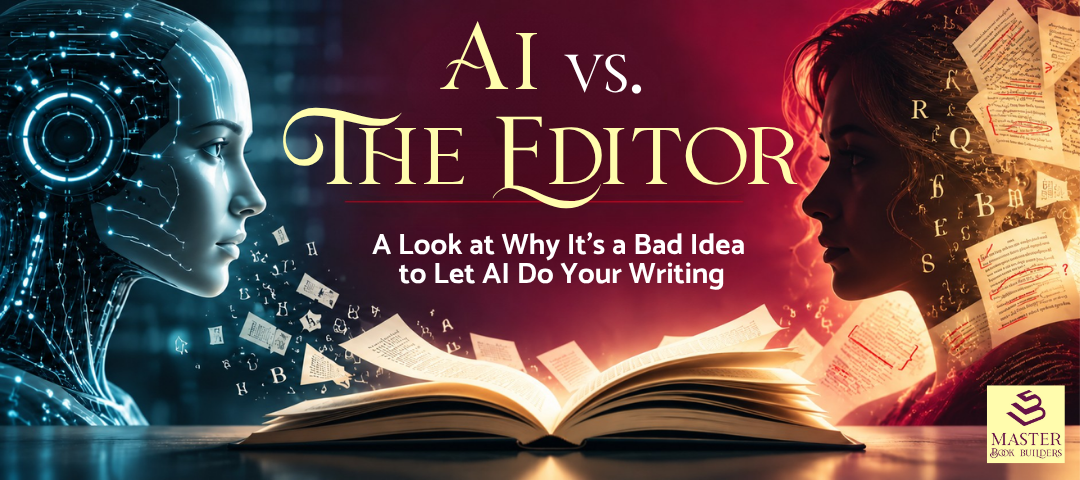
AI vs. The Editor. A Look at Why It’s a Bad Idea to Let AI Do Your Writing
Everyone is talking about AI and whether it can help or hurt your writing. This is a continuation of Tom’s post from last week, where he told us the good, the bad, and the ugly when it comes to allowing AI to do your work for you. His post was about learning. My post is about writing.
I’m going to dissect a post AI wrote for me (yes, I asked it to) about what developmental editors do.
To set the stage: I have many conversations with AI on a weekly basis. I wondered if it knew me well enough to write this post/newsletter. I understand a good many people are now allowing AI to write their newsletters. So, I thought I’d try it out.
Here’s what AI returned for my prompt to write this week’s newsletter describing what I do as a developmental editor:
“Every Author Needs a Developmental Editor. Yes, Every Author.
You finished your manuscript.
Congratulations! That’s a big deal.
Now comes the part where you need someone to tell you what’s wrong with it.
I know. Not nearly as much fun.
But that’s what a good developmental editor does. We don’t look for misplaced commas or argue about semicolons. That comes later.
We look at the book as a whole.
Does it accomplish what you set out to accomplish?
Is it organized in a way that makes sense to the reader?
Are you repeating yourself?
Did you spend three chapters explaining something that needs three pages—and three pages explaining something that deserves three chapters?
For nonfiction authors especially, there’s another problem: you know too much.
You’ve lived with your subject for years, perhaps decades. You know what you mean. You know why Chapter 6 naturally follows Chapter 5.
Your reader may not.
A developmental editor stands between you and that reader and asks the questions the reader will eventually ask.
What does this mean?
Why do I need to know this?
Haven’t you already told me this?
Wait. How did we get here?
And occasionally:
This is wonderful. Why did you bury it on page 187?
Even experienced writers need that outside perspective. Maybe especially experienced writers. We become too close to our own words to see what’s actually on the page instead of what we believe is there.
A developmental editor isn’t there to rewrite your book into our book.
Our job is to help you make your book better—clearer, stronger, more purposeful, and more valuable to the reader you wrote it for.
Before you worry about publishing, covers, Amazon, or marketing, make sure the book itself works.
That’s where I come in.”
Here’s how we unpack all of that, where the content in italics is me rewriting what the AI shared.
Title chosen by AI for this post: Why Every Author Needs a Developmental Editor.
Not bad, but I kept asking for other options and finally wrote my own. But AI did inspire me.
AI wrote: You finished your manuscript. Congratulations!
Nothing wrong with this except I work with authors while they’re writing their manuscript. I know other dev editors take a completed manuscript and do their thing, but that’s not me. AI should have known this. I work with it a lot. It knows how I do what I do.
I would write the above like this: Writing a book? I’m impressed. If you want the rest of the world to be impressed – or at least your chosen audience – you need to give your manuscript the right support. That means working with a good editor. Often, a developmental editor.
AI wrote: Now comes the part where you need someone to tell you what’s wrong with it.
What? I would never say that! I can get snarky sometimes, but I wouldn’t start out that way. I don’t know any editor who would. Not when dealing with a new, first-time author who is already worried about writing the book.
AI continued: That’s what a good developmental editor does. We don’t look for misplaced commas or argue about semicolons. That comes later.
This is true to a point. Many dev editors work with an AI tool to spot commas, word choice, repetition, and more, while we also work with the author on the purpose, the writing, and the flow of the book. In my work, I routinely disagree with the AI tool on these things. It doesn’t think like a human and repeatedly tries to rewrite content in its own voice, instead of understanding the author’s voice. Trust me, AI’s voice is boring at its best and outrageous at its worst. I know we’ve all heard the horrid stories about AI hallucinations where they return completely made-up links and content.

AI wrote: We look at the book as a whole.
Developmental editors do more than that. In my case, I look at the project as a whole – the author, the book’s purpose, the audience, and the book. I want to make sure the author is writing for a long-term goal – not merely publication, but purpose-driven results. I know others who do what I do would agree with that.
AI wrote: Does it accomplish what you set out to accomplish?
This is a good question. It’s not answerable at the beginning. Working chapter by chapter, this question may come up halfway through. Well before the book is done. IS the book on its way to accomplishing the goal we set out for it? Other dev editors do it differently by taking a completed manuscript, which might make answering this question easier, but it could be harder, too. In my work, several books needed that attention while the book was being written. I don’t know how those books would have turned out if they’d been completely written from the onset. No doubt, my AI tool took that question from content I’ve written online.
AI wrote: Is it organized in a way that makes sense to the reader?
This is correct, but I wouldn’t say it like that. Maybe other dev editors do, and that’s where the AI got that question. I would say that we need to review the book in its entirety to get a 50 ft view from the top.
AI wrote: Are you repeating yourself?
Just this week I commented to an author that we needed to look carefully at the four chapters we’d worked on to spot any unnecessary repetition. Because the AI is just asking this one question, it falls flat to me. Authors repeat themselves all the time. The goal is to spot the repetition that doesn’t work. So, my question would have been: Is there too much repetition, and why?
AI wrote: Did you spend three chapters explaining something that needs three pages—and three pages explaining something that deserves three chapters?
This sounds like the dev editor (which I supposed to be me) has the completed manuscript. I generally don’t work on completed manuscripts (though I have once or twice). I prefer working with the author from word one to finished conclusion and all the back matter also. This issue comes up during the writing process, not after.
AI wrote: For nonfiction authors especially, another problem is that you know too much. You’ve lived with your subject for years, perhaps decades. You know what you mean. You know why Chapter 6 naturally follows Chapter 5. Your reader may not.
I would rewrite this: For nonfiction authors, the readers want to know what you know. We all live with the curse of knowledge. I look for places where you’ve let yourself believe your explanation is enough when it maybe isn’t. In your book, it’s my job to make sure you don’t forget that other people don’t know what you know. (Because the AI comment isn’t wrong; it might have sufficed, except that’s not how I talk.)
AI wrote: A developmental editor stands between you and your reader and asks the questions the reader will eventually ask.
I wouldn’t put it that way. It’s correct, but I would say: A dev editor pays attention to your audience. We ask: Are you fulfilling the promise in your title and subtitle? Your readers are everything. Without them, the book languishes in Amazon purgatory or worse. We are always thinking like a reader as we work with you on your book. Once again, it’s a nuance the AI cannot repeat because it doesn’t understand how I write. It only thinks it does.
AI wrote (questions to ask the author): What does this mean?
Why do I need to know this?
Haven’t you already told me this?
Wait. How did we get here?
Instead of the above, I would ask my authors:
- Can you explain this better? I was confused, and others might be confused too.
- I think you’ve told us this too many times. Let’s describe what you’re trying to say differently now.
- Wait- didn’t you say something entirely different in Chapter 3? This is confusing. Let’s go over it and fix it.
AI wrote: And occasionally: This is wonderful. Why did you bury it on page 187?
Instead, I would say: This is really good (I might say wonderful). Do we need to move this closer to the beginning of the book? I will admit that a few times I’ve read something wonderful and asked the author why they didn’t share it sooner. It’s always great when the author recognizes that first. I think that’s a great working relationship.
Here’s something the AI never commented on: (After a conversation about the author’s life) That’s a great personal story to use in the book. Are you comfortable sharing it? Do we need to change names or rewrite it a bit to make it generic for you?
I don’t know if other dev editors find treasures like this in their discussions with their authors, but I do.
AI wrote: Even experienced writers need an outside perspective. Maybe especially experienced writers. We become too close to our own words to see what’s actually on the page instead of what we believe is there.

Personally, I find that AI comment confusing. I would say, like many dev editors, I’ve worked with established authors and also writers who are writing their first book. All of them need the benefit of eyeballs other than their own. If we, as writers, allow ourselves to be the only judge of the success of a book’s completion, we run the risk of navel-gazing.
“Navel-gazing is what happens when a writer’s work is so much about them, so much content they like – without thinking about what the reader likes and needs – they end up with a book that lacks purpose, seems self-indulgent, and turns readers off.”
That is what vanity press was all about – or is about. It’s still happening. Writers who write books that read like personal confessions, or who fail to show readers how their experiences mirror the reader’s, are all about the vanity of saying, “I wrote a book.” They forget it’s not about them, at all.
I especially like the way navel-gazing is described in this Reddit post by @PM_me_furry_boobs:
“It’s used to denote a vapid and/or pretentious focus on the self, and one’s own thoughts. Writing with an abundance of navel-gazing is probably filled with lots of observations and tangents that the author thinks are smart, but aren’t, and serve no function.”
And, from TaltosDreamer on Reddit- for fiction authors:
“In Sanderson’s context, it is when the writer spends pages and pages on their character’s inner thoughts, to the detriment of the story. Too much time exploring the mental workings of a character’s mind results in nothing actually happening.”
We’ve written about sci-fi author Brandon Sanderson before, and this post, The Indie Advantage, bears a review as it describes how he does his indie publishing through DragonSteel Books.
As a developmental editor, my job is to make sure my authors know that, yes, the words in their books are their words. But those words aren’t there just to make the author look good. Sentences and paragraphs exist to give the reader a reason to keep reading. They’re there to influence and transform other people’s lives. Even fiction. Fiction is about story, narrative, and relating to the audience the book is meant for. No different than nonfiction, if you ask this dev editor.
AI wrote: A developmental editor isn’t there to rewrite your book into our book.
This flows from what is directly above. It’s a good sentence. I might use it and elaborate a bit like this: Some folks think all editors try to rewrite authors’ books into their own words. Good editors do not. Our goal is to help smooth out the wrinkles. If something we write sits well with the author, that’s great. But I only rewrite an author’s content, or embellish it, to provide clarity. Then, I always urge the author to revise in their own words. Often, they say No, what I’ve written is fine. So, we keep it. But again, the words I write are in the author’s voice. Which is something I’ve learned throughout our time together.
A developmental editor’s job is to serve the client (the author) by paying attention to how the content will read for the readers. I always say I serve the author, but my allegiance is to the reader.
AI wrote: Our job is to help you make your book better—clearer, stronger, more purposeful, and more valuable to the reader you wrote it for.
This is true.
AI wrote: Before you worry about publishing, covers, Amazon, or marketing, make sure the book itself works.
Truth is, all of that is part of writing the book. Yes, we want to understand at the outset what the book is about and who it is for, but the cover, publishing, Amazon, marketing- that’s all part of the project. I would not say the above sentence unless it came up in conversation. I wouldn’t write it here.

And so…
In conclusion, in my work, and I suspect in many other dev editors’ work, we want the book to be everything the author wishes it to be. Good writing is just one part of writing a successful book. In most instances, all of us – editors and writers – want books to mean something. To make a difference.
You’ve heard me say that if you’re writing a book to be rich and famous, I am not the editor for you. I wonder why the AI tool didn’t mention that? I’ve written about it. Truth is, I’ve met too many authors striving to be rich and famous, and most of them fit into the navel-gazing category. Everything is about them. Their work is middle-schoolish. They believe their story is all they have to tell. They leave out shared human experiences, historical context, and broader social truths. (Much like AI when it writes.)
The beauty of what I do, and what all editors – developmental editors and other kinds of editors – do, is that we have a passion for the written word. We know the power of writing a good book. And it means using a human voice.
Throughout this post, my goal was to demonstrate the good, the bad, and the ugly of AI when used to write something in your voice – a human voice. The AI tool I use knows me well. We have many long conversations. However, it only captured a small part of my voice when it wrote its version of this post for me (see above).
This is because AI doesn’t think; it’s not alive, and no, it does not have consciousness.
At Nature.com I was struck by this quote:
“We believe that mathematical algorithms implemented on graphics cards cannot become conscious because they lack a complex biological substrate.”
When it comes to writing, it clearly doesn’t understand personality, tone, or emotion.
I mostly ignore my AI’s suggestions to rewrite my words. It was actively trying to do so throughout this post. If I had let it do that, this post would have been bland and boring. I wanted to write ‘blah’ but I chose boring. Would AI have been able to tell you that? No.
AI is a useful tool. It’s not a useful friend. Every question you ask is answered with what it believes you want to hear, not the truth of what you need to hear. Its only goal is to return (note that word: return; that’s what it does; it doesn’t ‘think,’ though it pretends to). It searches online faster than you or I ever could, and it returns the answer it believes you want to hear. Good or bad. Right or wrong. True or false.
It’s not a substitute for your own words, written in your voice. As Tom said in last week’s post, AI May Well Kill Your Writing, “I know it can feel like you’re being more efficient and productive using AI in your writing. But is it worth producing more, if your writing gets shallower, becomes homogeneous with everyone else’s, and you feel less ownership of the ideas?”
What did I miss? What are your feelings about AI? Are you ready to let it write for you? Edit for you? Proofread for you? Tell us how you use AI in the comments.
As always, connect with me on LinkedIn.



Leave a Reply