

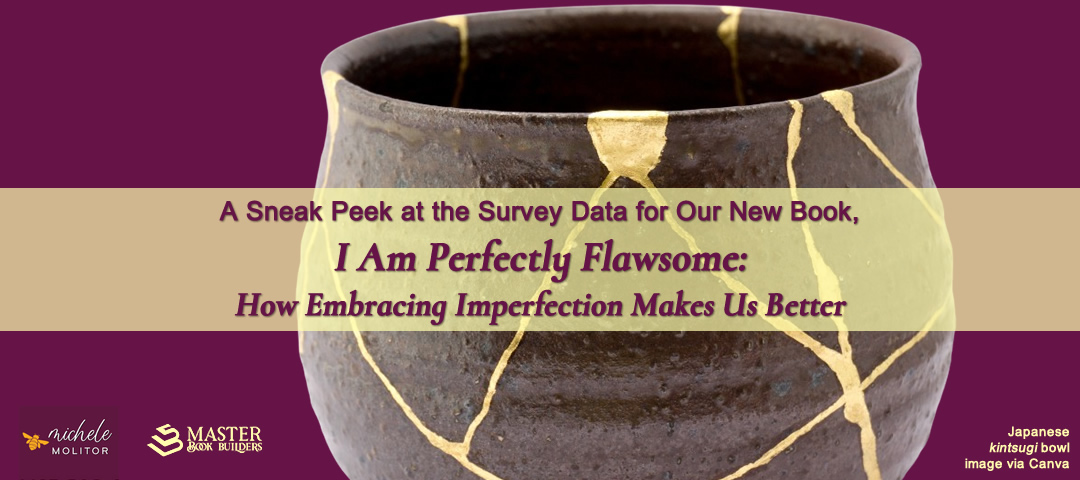
Surprise: A Sneak Peek at the Perfectionism Survey Data for our upcoming book, I Am Perfectly Flawsome
Have you noticed how much chatter there is online about perfectionism? A quick search brought over 60 million results, but just skimming down the first page showed commentary ranging from health-focused bloggers to the Harvard Business Review about how to identify and deal with perfectionism and perfectionists.
As one who’s struggled with it myself, I’ve dug into the growing body of research and written about it over the last few years. But I recently got more involved and found that a friend, Michele Molitor, has been on a similar path, so we’re now deep into writing this book together. The research for our book included conducting our own online survey to gain additional understanding of the scope and some of the nuances of attitudes and experiences around perfectionism.
Here are some quick learnings from our data about perfectionism today:
It’s a BIG Problem
83% – that’s how many participants (all adults, age groups from 18-60+) answered yes to the question,
“Do you feel pressure to be perfect from yourself, from those close to you, or from society?”
That means most people in most families, social groups, and workplaces are feeling pressure to be perfect. And it comes from inside, from those around them, from society, or from more than one of these sources, referred to in the research literature as self-directed, other-directed, and socially prescribed perfectionism.
We’ll be laying out the case in a lot more detail in the book, but I’ll just forewarn you that there is NO SUCH THING as positive, or adaptive, or useful, or moderate, or normal, or any other adjective used with perfectionism in an attempt to mollify those who call themselves perfectionists and wear the label like a badge of honor.
In simplest terms, as I wrote in a post a couple of years ago: Imperfect is all there is. Chasing perfection “means stubbornly reliving failure and disappointment.” And the research shows this leads to much more serious physical and emotional problems.
I like the way one classic article drew the distinction, correctly in my view, between perfectionism and the mindset that the author called
“the healthy pursuit of excellence by men and women who take genuine pleasure in striving to meet high standards.”
In contrast, the article described perfectionists as
“those whose standards are beyond reach or reason, people who strain compulsively and unremittingly toward impossible goals and who measure their own worth entirely in terms of productivity and accomplishment.”
The consequences of perfectionism are dire, as Brené Brown explained in Daring Greatly:
“Perfectionism is not the same as striving for excellence. . . .
Perfectionism is not the key to success. In fact, research shows that perfectionism hampers achievement. Perfectionism is correlated with depression, anxiety, addiction, and life paralysis or missed opportunities. [It] keeps us outside of the arena where healthy competition and striving unfolds.”
There’s a host of research backing up those consequences and others that we’ll cover in the book. But two specific stats stand out from our own survey:
- 64% of those across the age groups from 18-59 reported that pressure to be perfect had harmed their relationships
- And 73% of those aged 45-59 said perfectionism had caused negative consequences in their careers
It Starts Early
Nearly two-thirds (64%) of our participants reported feeling pressure to be perfect as children.
A majority of the overall sample (53%) also answered yes to the question:
“Did pressure to be perfect as you were growing up interfere with your performance (e.g., willingness to try something new, take risks, or turn in assignments on time) or your relationships with others?”
But 100% of those currently in the youngest age group (18-29) answered yes.
We’ll explore this further in the book, where we’ll dig into the narrative answers and follow-up interview on this and other aspects of the raw data.
Once again, the consequences of perfectionism in children can be serious. A recent book on helping children overcome perfectionism noted:
“[P]erfectionism at a young age can lead to more serious conditions, such as suicide, eating disorders, depression, and anxiety disorders as it progresses.”
It’s getting worse
One recent survey article reviewed more than 30 years of research and warned of an
“apparent rise over time in the prevalence of self-oriented, other-oriented, and socially prescribed perfectionism [and that] the prevalence of dysfunctional forms of perfectionism among young people has reached alarming levels.”
Our new survey data seems to support these observed trends. Lurking beneath the startling number that we started with above — that 83% of the overall sample felt pressure to be perfect as adults — were these even more worrisome results:
- 100% of the youngest adults (18-29) answered yes to feeling pressure to be perfect both as children and as adults
- 88% of the 30-44 age group answered yes to feeling such pressure as adults
- 100% of both of these younger groups also answered yes to the question whether they had ever regarded themselves as perfectionists
There is hope
As noted above, a great deal of research has been done over recent decades, contributing some useful tactics and treatments for overcoming perfectionism. Michele and I are working to contribute further ideas and some specific tools to the field.
One reason for our optimism comes from the survey, where nearly two-thirds of the overall sample said yes to the question,
“Have you found ways to overcome your own perfectionism, or observed others do so?”
And equally encouraging, the two younger groups (18-29 and 30-44) had the highest rates of yes answers, 100% and 75%, respectively. In the narrative answers and follow-up interviews, we asked them for examples and, of course, will be discussing the best of them in the book.
That’s it for this sneak peek! Gotta get back to the writing and my client work.
Meanwhile, be sure to get on the waitlist for the book here. You’ll receive early bird book launch specials and be eligible to win some fun prizes!



1 Comment
Leave your reply.