

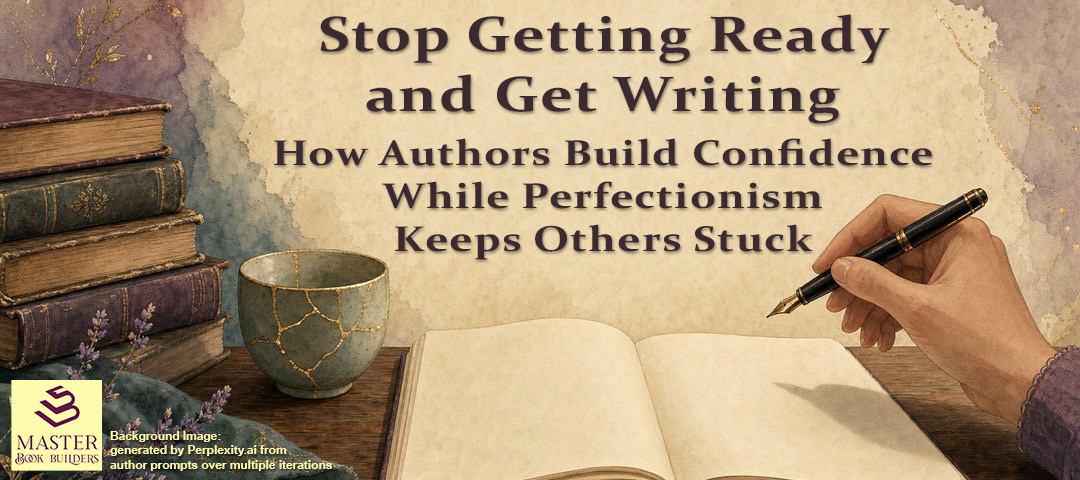
Stop Getting Ready and Get Writing: How Authors Build Confidence While Perfectionism Keeps Others Stuck
Where do would-be writers gain the confidence to become authors?
I got thinking about that question when I read a post talking about how to help girls “be confident” starting with the notion that telling them to “be confident” is not much help. The problem, according to the piece, is that girls don’t know what that means. But the advice offered boiled down to parents and others should model confidence.
To me that begged the question, where did the role model gain their confidence? And aren’t we all more confident at some skills than others, in some settings than others, with some people than others?
The skills part of the second question led me to writing and the problems we see so many people struggling with when they say they want to write a book, but haven’t. Some have notes. Some have outlines. Some have first chapters in a folder somewhere. Some have been “getting ready” for years.
They are not lazy. They are not unserious. Many are reading, researching, taking courses, refining the idea, looking for the right structure, studying the market, waiting for the right season, looking for approval from an agent or editor, or trying to become the kind of person who is finally allowed to write the book.
Yes, preparation can be useful. But preparation all too often becomes a trap, a seemingly respectable way to put off starting. Perfectionism rears its head and becomes that voice telling you that “stuck” is just being responsible.
Flawsomism Instead
Let’s get one thing clear: I am not arguing against excellence.
I like excellent books. So do readers. Please care about your reader. Please revise the weak paragraph. Please check the facts, improve the structure, sharpen the opening, and cut the sentence that only survived because you were proud of it on Tuesday.
But as Michele Molitor and I explained in our book, I Am Perfectly Flawsome: How Embracing Imperfection Makes Us Better, perfectionism is not the same as striving for excellence.
We urged holding a paradox: embracing, even celebrating, imperfection while simultaneously striving for excellence. We offered the Japanese art and philosophy of kintsugi, or golden repair, as a model.
The coffee mug in the banner image above illustrates the art form, showing how the cracked or broken piece can be repaired, the repairs decorated with gold, and the resulting piece become more beautiful and valuable than the original.
As a philosophy, we showed how the kintsugi mindset encompasses four more Japanese concepts:
- wabi-sabi, celebrate imperfection in everything
- shikata ga nai, accept what cannot be changed
- kaizen, continuously improve
- ganbatte, always do your best
The paradoxes among these avoid getting stuck in a perfectionist trap. You understand that nothing is, or can be, perfect and those golden imperfections add beauty to everything. While there are things you cannot change, most things you can always improve. But the very notion of continuous improvement means your best today will not be as good as your best tomorrow.
For writers, the perfectionist trap can look like:
- “I need more research before I start.”
- “I need the structure nailed down first.”
- “Other people have said this better.”
- “Who am I to write this?”
The flawsomist writer recognizes that they will likely need more research, but writing about their idea with the research they have will help define what additional research is needed.
That the structure will evolve as they write and learn, regardless of how it starts out.
That only after creating an imperfect draft can they work on improvement.
That there will be both cracks and beauty in the words they write today.
They get writing on that flawsome first draft.
So Where Does Writing Confidence Come From?
Narrowing the focus to confidence about writing gives us the clue needed to find its source. Researchers use the term “self‑efficacy” to describe:
“a personal belief in one’s capability to organize and execute courses of action required to attain designated types of performances. Often described as task-specific self-confidence …”
That’s what we’re after here, task-specific self-confidence. More useful than the generic “be confident” that got us started, it asks: confident to do what?
For writers, it’s the difference between a generic belief they’re a good writer, or the exhortation to “be” a good writer, and more precise confidence that they can:
- write one paragraph
- explain an idea clearly
- draft a messy chapter
- receive feedback without collapsing
The paper linked above notes four sources of information we use to build our task-specific self-confidence: mastery experiences (practice and performance), observation of others (role models and study), feedback (from others and objective measurement), internal physiological and emotional feedback (self-evaluation).
All these are forms of evidence you use to begin constructing and growing that belief in your ability to write.
Practice Your Writing Craft
The research shows that the first source, mastery experience, is the most influential. Not research or any other form of preparation. Experience with writing. Not a whole book as your first experience. Collecting evidence, one task-specific piece at a time.
I wrote today. I finished that scene. I revised that paragraph. I asked a better question. I learned how to open the chapter. I asked for (and survived) feedback. I made the work stronger.
Writing a book is not one skill. It’s dozens of skills that start at the word and sentence level. You must identify the skills you need to improve and work on them individually.
Deliberate practice research emphasizes structured activity aimed at improvement, with clear targets, feedback, and repeated revised attempts. In describing deliberate practice for music students, the paper mentions how a teacher will “organize the sequence of appropriate training tasks and monitor improvement to decide when transitions to more complex and challenging tasks are appropriate.” In other words, they don’t start by playing Mozart, but with discreet techniques like scales and chords. A writer may seek help organizing their sequence of tasks from a writing class or developmental editor.
You get mastery experiences with these small steps and small wins. You accumulate the evidence of your growing skills to prove your case to that jury inside your head.
Learn From Other Writers
This might sound like more preparation, but don’t fall into that trap. I’ve written a whole book about reading and included plenty of evidence that way of learning will improve your thinking and writing skills. Here are two short versions on that point from William Faulkner and Stephen King:
“Read, read, read. Read everything — trash, classics, good and bad, and see how they do it. Just like a carpenter who works as an apprentice and studies the master. Read. You’ll absorb it. Then write.”
— Faulkner
“If you don’t have time to read, you don’t have the time (or the tools) to write. Simple as that.”
— King
But that doesn’t mean wait until you’ve read … well, how many books would it take?
No! Keep reading, but start writing now. As you do both, you’ll be able to focus on techniques that you want to improve. You’ll start noticing how the authors you admire handle those challenges. That gives you a specific technique you can aim your deliberate practice at.
The researchers call this learning-from-others source of self-efficacy “vicarious experience” and one aspect is to foster a belief that, if that author can do it, then with persistence and effort so can you. Even books by authors who aren’t (yet) famous can help you improve your writing, showing you both what to practice and in some cases what to avoid.
You can also learn from other writers by joining a writers group, in person or virtual. One interesting variation is the global non-profit Shut Up & Write!, which provides a way to find and operate writing groups with a specific three-step structure: gather and share what you want to get done that session; shut up and write for a set time; check in and chat. While you may report what you did, there is “no critique, ever.”
A study conducted on a Shut Up & Write! group of medical students and young faculty found “significant gains in self-efficacy and self-regulation, suggesting that participation … may increase writing productivity.”
Cherish Feedback
A critical piece of deliberate practice is feedback. In the research, the focus was on “practice activities that offered immediate feedback and opportunities for repetition after reflection” in settings involving a teacher or coach, or a measuring device like a sound recording or a stopwatch.
For writers, we have many other ways to get feedback. A few examples: editors, beta or ARC readers, members of a writing group, co-authors, and eventually the readers of your last book.
Take all such feedback as a gift. A gift that comes with a return label and gift receipt. Most will be given with a helpful spirit, meant to help you improve. Some will be from unqualified sources or simply mistaken. You get to decide, after reflection, which is worthy of your time and effort in your ongoing deliberate practice.
The research warns that this source of information can be unreliable and actually lower efficacy beliefs. Both overly optimistic feedback and unjustly negative feedback can have that effect. So be aware and ready to ignore what does not apply to your writing style, goals, or audience.
As with practice itself, you can get better feedback results by asking specific questions about the piece. Don’t ask, “Do you like it?” Instead, focus on the technique you’re working to improve:
- “Where did you first feel confused?”
- “What sentence made you want to keep reading?”
- “What promise do you think this chapter is making?”
- “Where did I assume knowledge the reader may not have?”
So set rules. Ask for one kind of feedback at a time. Protect early drafts from final-draft criticism.
Look for golden repair.
Not people who smash the bowl.
Not people who insist the bowl has no cracks.
People who help you see where the repair belongs.
Harness Your Internal Voices
The fourth source of evidence of self-efficacy, or confidence, comes from your mind and body. How does your latest piece make you feel? Like external feedback, this one is double-edged.
What you want is that feeling of accomplishment that I hope you felt vicariously when reading the listing of tasks above that I’ll repeat here: I wrote today. I finished that scene. I revised that paragraph. I asked a better question. I learned how to open the chapter. I survived feedback. I made the work stronger.
And someday soon, that feeling of indescribable joy when you open the box with the print proof of your book.
What you want to avoid is that voice labeled imposter syndrome. That fear-based voice that keeps telling you you’re not ready, not good enough, and if you let anyone see what you write, the world will find out.
Among the ways to silence that internal critic, naming it has proven effective. In our book, Michele explains that she named hers “Amy” because the amygdala in our brains processes emotional responses like fear, anxiety, and aggression. When she feels those negative emotions welling up, she tells Amy to calm down, she’s got this.
And researchers tell us that another key way to quiet those voices involves objectively examining and rejecting the voice’s claim by reminding yourself of your past achievements, that you’ve done it before. Because you’ve been accumulating those small wins through deliberate practice, right?
Note here that even if you’re just starting out, you can rely on cross-over confidence from having learned other skills, all the way back to walking or riding a bike, as evidence that you are capable of learning this one.
So Get Writing on Your Shitty First Draft!
I’ll close with Anne Lamott’s famous advice in her book on writing, Bird by Bird:
“[E]ven better news than that of short assignments is the idea of shitty first drafts. All good writers write them. This is how they end up with good second drafts and terrific third drafts.”
As we’ve covered, it’s also how you begin building confidence by gathering evidence that, yes, you can get something written. And yes, you can edit it into something better. Still not done, but better.
Lamott goes on:
“Very few writers really know what they are doing until they’ve done it.”
So you’re not alone in thinking you don’t know what you’re doing at first. Nobody does. Write anyway.
From my own experience, three drafts are not usually enough for book-length writing. But Lamott offers this useful writing construct that she got from a friend:
“Almost all good writing begins with terrible first efforts. You need to start somewhere. Start by getting something — anything — down on paper. A friend of mine says that the first draft is the down draft — you just get it down. The second draft is the up draft — you fix it up. You try to say what you have to say more accurately. And the third draft is the dental draft, where you check every tooth, to see if it’s loose or cramped or decayed, or even, God help us, healthy.”
You should get Lamott’s book, but you can read the section on Shitty First Drafts here.
If the mere mention of dental work gives you cold sweats, go back to our kintsugi metaphor. You’re not perfect, but your imperfections make you unique and the ones that need mending will be more beautiful when you’ve done the work.
The same for your writing. Get going.




Leave a Reply