

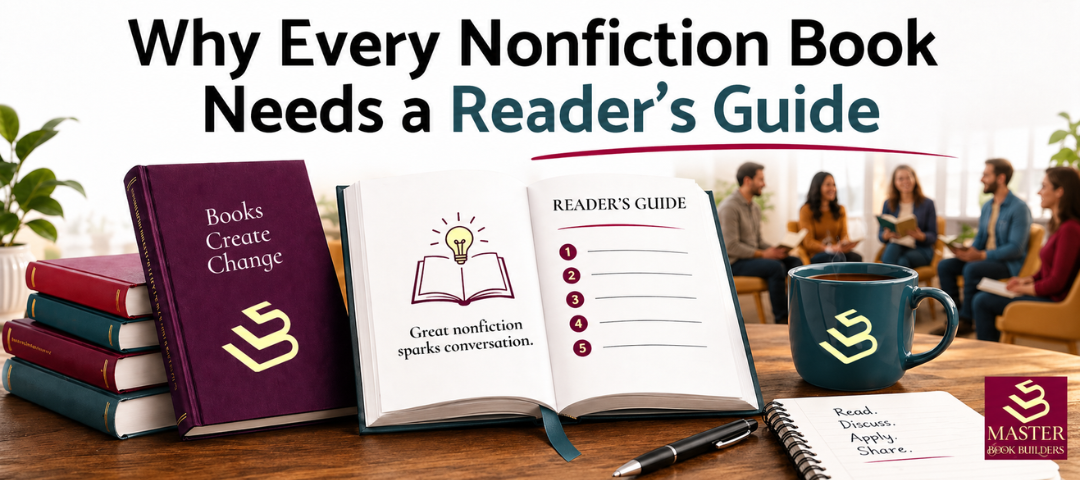
Why Every Nonfiction Book Needs a Reader’s Guide
We’ve often recommended writing a reader’s guide for the back matter of our authors’ books. Our reasoning is that many books’ topics are fairly broad and their contents are written to spark discussion, so a reader’s guide can be a worthwhile addition to further that discussion.
It should also be noted that book clubs appreciate reader’s guides. Some might require them. The guides help them begin the discussion and keep it going, especially if the author offers insight into a particular section or story they wrote.
By the way, this is all part of your job as an Authorpreneur, which I wrote about in December of 2025. Thinking like a business professional and treating your book as a new small business will help you achieve results faster and more effectively. Now, I’m also saying you might want to include a reader’s guide to help your ‘book business’ be successful.
Larry Sommers, author and college professor, says this about reader’s guides for nonfiction books:
“One way to engage readers beyond the last page of your book is to provide a set of discussion questions. Educators, book clubs, librarians, and curious readers appreciate the extra information because a book discussion guide takes them behind the scenes, so to speak.”
If you think about it, a reader’s guide can turn a nonfiction book from something people simply read into something readers can discuss, apply, teach, and recommend. For authors, coaches, speakers, and subject-matter experts, that makes a guide more than a bonus download; it becomes a practical extension of the book itself.
What is a reader’s guide?
In publishing and education, the term “reader’s guide” can refer to a discussion guide, a classroom or educator guide, or a guide shared at the end of the book to help readers engage more intentionally with the book. Occasionally, authors will add similar questions at the end of each chapter. These questions can become part of the bigger reader’s guide or be an introduction to the content in the reader’s guide.
Some librarian-facing resources use the related term “reader’s advisory” to describe tools that help connect readers with the right books, but for authors, the most useful kind of guide is a companion document that helps readers engage more deeply with the message shared in the book.
For nonfiction authors, a reader’s guide is most often thought of as a structured companion to the book. Created by the author, this document offers readers questions, prompts, and activities that help them reflect on the book’s message, discuss it with others, and put its ideas into practice.

Why it matters for nonfiction
Our authors at Master Book Builders write their books to create change. Their books are meant to teach, inspire, coach, challenge, clarify, or show readers how to do things differently or to learn new skills. Some are written to improve the reader’s mental health or physical health. All of these are books that matter!
A well-designed reader’s guide supports the purposes mentioned above by helping readers pause, process, and apply what they have read, whether that’s with a friend or colleague, in a mastermind group, or with members of a book club.
Book clubs, workshops, mastermind groups, college classes, staff teams, and professional associations all benefit from having ready-made prompts and discussion questions. This enables easier discussion, given the reluctance some folks have to be the first person to speak. With a reader’s guide, the members of the book club or other gathering have a done-for-you prompt that inspires conversation. When an author supplies a relatable reader’s guide, meetings around the topic become easier to teach, easier to recommend, and easier to use.
Done well, a reader’s guide can also drive word-of-mouth growth. Readers may be more eager to share the book if they’ve benefited from the insight shared in the reader’s guide.
Preparing a strong guide doesn’t need to give you heartburn!
Guides can be simple and easy to develop, and they don’t need to be long. However, your guide does need to be intentional. Note the word intentional. Don’t think you can throw together a few questions and prompts and call it a day. The strongest examples typically include a mix of orientation, reflection, and action so readers can refer back to specific chapters or passages, with questions that help them understand why those passages matter. Good guides nudge them on what to do or discuss next.
The true purpose of your guide is to help spark a conversation about the book that goes beyond the last page.
A practical nonfiction reader’s guide should include most, if not all, of these:
- A short introduction explaining how to use the guide and who it is for.
- Discussion questions that go deeper than recall and invite interpretation, reflection, and conversation.
- Personal journaling prompts that help readers apply the material to their own work, relationships, or goals.
- Group activities or exercises for teams, classrooms, coaching cohorts, or book clubs.
- An author Q&A or behind-the-scenes note that adds context and personality.
- A short list of next steps, resources, or invitations for readers who want to keep going.
Questions worth asking
One of the most important lessons from reading-guide and educator-guide models is that the best questions do more than test comprehension. They help readers think, connect, and respond.
They often focus on feelings. On emotions.
For a nonfiction book, questions fall into a few useful categories:
- Understanding: What is the author really saying here? What is the central idea of this chapter or passage?
- Reflection: Where does this idea show up in your own life or work? Did this passage remind you of something in your life?
- Application: What is one action you could take this week based on what you just read?
- Discussion: Which idea in this section do you agree with most, and which one challenged you?
- Extension: What would this concept look like in a team, classroom, family, or business setting?
Focusing on what the reader learned or what thoughts the passages raised keeps the guide from feeling like homework.
How to shape a guide for YOUR kind of book
Every book is different – even those written around the same topic or message. This means you should think carefully about the kind of guide you produce for your book.
A business book about leadership may need team discussion prompts and implementation exercises, while a memoir with a message may need more reflective questions and story-based conversation starters. A prescriptive how-to book may benefit from worksheets, progress tracking, or chapter-by-chapter action steps that help readers practice what they are learning.
The key is to match the guide to the book’s real-life use. If readers are likely to use the book in workshops, include facilitation-friendly questions. If the book is likely to reach book clubs, create discussion prompts that spark lively conversation. If the book supports speaking or teaching, add exercises a host or instructor can use right away.
The American Christian Fiction Writers website has a great post on “Writing Effective Book Club Discussion Questions,” which I think is helpful for nonfiction, also.
#3 in the post speaks to #6 in the simple structure below: (the author of the post, Sarah Sundin, says to create 12 -20 questions, thereby giving your readers a choice of which ones suit their purposes.)
3) Include some personal questions. Many book clubs love these (like mine!), and individual readers often like to go deeper. For example, “Roger Cooper goes out of his way to avoid women. How do you handle known temptations in your life?”
A simple structure any author can use
With the help of Perplexity but with my edits and input, I created this starting point, which uses a seven-part structure:
- A short how-to — Tell the reader who the audience is for the guide. Is it meant for solo readers, groups, teams, classrooms, or all of the above?
- Book summary — What is the book’s core message? State the book’s promises and what transformation the reader might have experienced.
- Part-by-part or chapter-by-chapter questions — Choose a few select passages, not necessarily from each chapter, but focused on the transformation in #2, and include a small set of thoughtful prompts for each.
- Reflection and action pages — Ask simple questions: How did this make you feel? If you’ve experienced this, also, what did you do about it? Reflect on this passage – does it inspire you or leave you confused? Why? This helps readers connect ideas to their own next steps.
- Group discussion or activity ideas — Offer easy ways to use the book in conversation or training. If you haven’t done anything like this before, tap into Perplexity or another AI to show you how. Remember to have a conversation – ask specific questions, make your prompt about the work, not you, and then ask the AI to refine its answers until you feel you have what you need. Then, rewrite it in your voice.
- Author note or Q&A — Add depth, story, and personality. You can really shine here. Share a behind-the-scenes look at your world. Create a QR code for your website that points to images of your writing space or videos of you walking your dog. Get personal.
- Resources and next steps — Point readers toward tools, follow-up learning, or ways to stay connected. Remind readers of your office hours, or other downloadable content on your website.
This framework is flexible enough for most nonfiction books and simple enough to turn into a downloadable PDF, bonus ebook, or website resource if you want to expand it beyond your reader’s guide.
Why this helps you, too
A reader’s guide is also good for your brand. I wrote about author branding in 2024, and though I didn’t include readers’ guides, I did include a lot of other important advice you might want to hop over and review.
A truly valuable reason to have a reader’s guide, beyond branding and giving readers a little help in their discussions of the book, is that it can make the book easier to use in speaking engagements, workshops, consulting, book clubs, educational settings, and community discussions.
You can also use it to direct people to your website, to join your email list, or to continue the conversation with you by engaging online.
A strong guide can extend the life of your book. It’s one more way to be useful, one more reason for readers to share the book, and it’s a solid link between the reader and you.

Final thought
I like to say that I never want your nonfiction book to just sit on a reader’s shelf! A reader’s guide is a simple but smart companion piece for any author and any reader to keep it from gathering dust on that bookshelf. A reader’s guide brings the whole book alive!
Think of it as part of the book’s real-world impact.
If you have questions about creating a reader’s guide, share in the comments. If I can’t answer it here, we’ll set up a time to talk.


1 Comment
Leave your reply.