

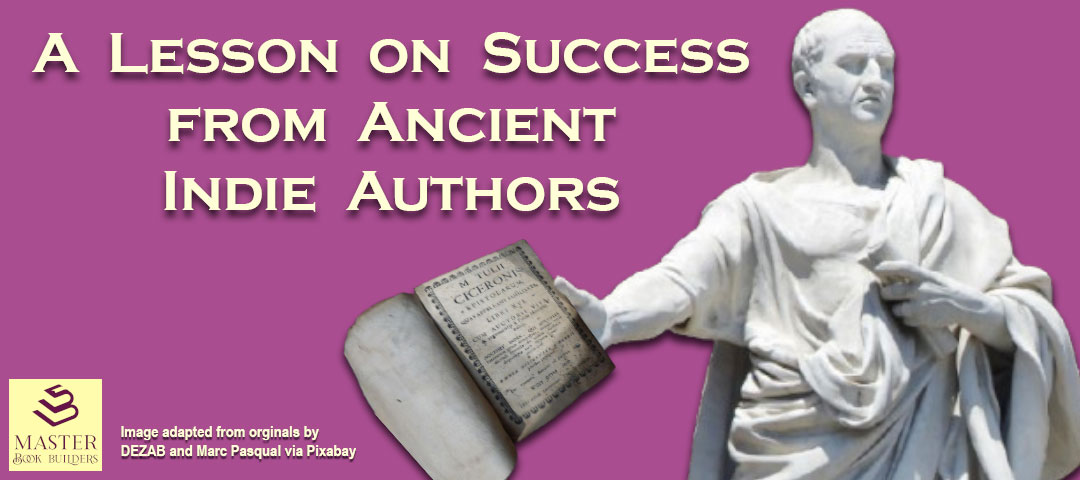
Marginalia: A Lesson on Success from Ancient Indie Authors
Imagine a world with no Big Five Publishers. No publishers as we know them at all.
No such thing as copyright.
Now imagine you’re a person with ideas, a message, stories you feel compelled to share with others. You’re intelligent, ambitious, and you’ve seen others getting theirs out in the form of books. You’ve acquired the skills of reading and writing.
Most of your experience has been with papyrus scrolls, but you’re also familiar with a new format of pages with text written on both sides and then bound together in what they’re calling codices.
That’s the world ancient authors faced in Roman times, as described in Papyrus: The Invention of Books in the Ancient World, by Irene Vallejo. So, how did you go about creating a book, publishing, and distributing it?
The OG Indie Publishers
As Vallejo explains that when an author finished writing their book they,
“… commissioned a certain number of copies and started giving them away to all and sundry.”
She gives an example of one Regulus, who had the means to commission a thousand copies of his book. He sent them to those he knew throughout the empire. But in a tactic that sounds a bit like paying influencers and a bit like having an audiobook edition, as well,
“He also contacted several decuriones [cavalry officers] in the Roman legions, paying them to select the soldiers with the best voices from among their ranks and organize public readings — a kind of book launch — all over the empire.”
Then, as today, the primary responsibility for marketing a book “fell to the writer.” For those without wealth of their own, that meant finding a patron to finance the copying and provide connections to an audience.
But once that initial circle had received and read the book, how could it be spread further? How could Ovid boast that his books “were widely read ‘all over the world'”?
When someone learned of a book or an author whose work they admired, the primary way to get their own copy was to borrow one from a friend or a private library and have it copied by a slave or a scribe.
Have you noticed that not a single copy of these books were sold? Without any concept of copyright, there were no such things as royalties. As Vallejo noted, the only ones who made money from producing books were the professional scribes who copied them. The authors themselves,
“… knew from the outset that there wasn’t the slightest hope of making money from selling books.”
Why, then, did so many put in the enormous effort of writing books in the first place?
Success for Cicero
Here are the reasons given by Vallejo for an ancient author such as Cicero to write and publish books, reformatted as a list:
- To achieve his social and political ambitions
- To increase his fame and influence
- To fashion a public image in keeping with his self-interest
- To make sure that his friends — and enemies — were aware of his success
She adds that the patrons who supported authors without their own wealth and power were seeking similar goals: reflected glory, showing off their own status, and flattery.
As she put it,
“Books primarily served to create or cement certain people’s prestige.”
The Lesson Remains True Today
Sounds a lot like what we tell nonfiction authors all the time. There are many ways publishing a book can generate income and advance your career. Royalties from selling thousands of copies may be the least likely of all of them.
I wrote about 10 Ways Writing a Book Builds Business Success not long ago. Among those that would have applied fully to Cicero and his contemporaries:
#1 Increased Credibility and Expert Status
#4 Speaking Engagements
#5 Strategic Partnerships
Today, indie authors can monetize their nonfiction books in these ways, and more directly by growing their businesses that provide services aligned with the topics in the book.
And of course, these success metrics still depend on that other lesson from the ancients: the task of marketing the book “falls to the writer” and getting it into as many hands as possible to achieve the success described above may involve giving it away as much as selling it.




Leave a Reply