

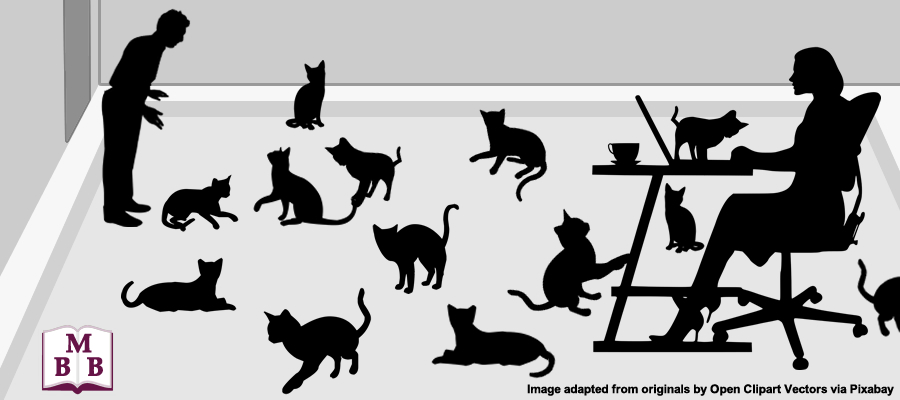
Writing a book only FEELS like herding cats
We know it’s not easy. As they say, if it was easy everybody would do it. And you’d have that book inside you published already.
The herding cats analogy came to me as I was reading Building a Story Brand: Clarify Your Message So Customers Will Listen, by Donald Miller, which this excursion into Marginalia will explore. Although Miller built his book around the classic seven-part Hero’s Journey storytelling template, three things make it stand out for me:
- His focus on using stories in business marketing with lots of examples, makes crystal clear the value of distilling the benefits of your product or service into a story with your customer as the hero.
- The structure of the book as a step by step process for building your brand story, with a simple (though not always easy) exercise in each chapter, helps get you through to completion of your Story Script.
- By seeing your book as the product or service and your reader as the hero, the lessons of Miller’s book can be applied to both writing and marketing your book.
About those cats
The herding cats idea appeared as I was working on the exercise for identifying and defining the hero’s problem. Miller urges you to “personify” the problem in the form of a villain. Think: the little green glob of chest congestion that talks to us on TV about Mucinex relief lasting, “12 hours!”
Miller breaks down the problem into three layers, external (the outside barrier that the villain causes), internal (e.g., the hero’s self-doubt or reluctance to take on the challenge), and philosophical (the “good” of achieving the hero’s goal vs. the “evil” of the villain preventing it).
He then points to a danger:
“But be careful. A large problem most of our clients face is they want to include three villains and seven external problems and four internal problems, and so on.”
Too many cats!
Miller makes the point over and over that,
“[S]tories are best when they are simple and clear. We are going to have to make choices.”
Before we shift to how writing a book often feels like herding those cats (and many more), but doesn’t have to, let’s finish off Miller’s point with his 4-question technique for clarifying the hero’s problem:
- “Is there a single villain your brand stands against?”
- “And what external problem is that villain causing?”
- “How is that external problem making your customers feel?”
- “And why is it unjust for people to have to suffer at the hands of this villain?”
This technique should be helpful to you when you get to marketing your book. And for rounding up those cats during the writing process, too.
The cats in your head, on your blog, in your manuscript
No matter where you are in the writing process, that herding cats feeling can strike.
When you first make that commitment and sit down to write, a lot of ideas that make up your compelling message go banging around in your head. Those might be the cats.
You want to organize them and get writing. But you find one rubbing against your leg, two more stalking each other in circles, several more stretched out on the furniture ignoring you, and the biggest one sitting on your keyboard demanding to be fed or belly-rubbed.
Or you might have a ton of written material posted on your blog or elsewhere over the last few years. Great content just waiting to be pulled together into book form.
But right now each piece looks an awful lot like a cat. Same scenario, with the rubbing, the lounging, and that demanding look on the furry face.
And even if you have a completed manuscript, you know it’s a draft. It needs the touch of a professional book coach or developmental editor. Revision will happen. Parts may need to be moved around, even whole chapters added or (gasp!) deleted.
Again with the cats!
But for you, the author, it’s even more complicated. Because your book will be filled with stories.
Each one should comply with Miller’s “simple and clear” mantra, but there will be lots of them.
In a nonfiction book, you’ll provide stories to illustrate your points and inspire your readers.
In fiction, you’ll have the main story, of course, but also many individual stories as subplots, character development, backstory, and so on.
A guide for a guide
Instead of seeing cats in all your ideas, or separate writings, or parts of a raw manuscript, view them as building materials.
Now all you need are a good set of blueprints, the right tools, and an experienced project manager to guide you through to move-in day. Or in this case book launch day!
In our book, we lay out a 5-Step book writing and publishing process using this building analogy:
Step one: Your idea! (the foundation)
Step two: Blueprints (outlines, chapter titles, subheadings)
Step three: Floorplans and “shop drawings” (writing, storytelling, editing, reorganizing, rewriting)
Step four: Exterior design (the cover, front, back, and spine)
Step five: Interior design, furnishings, as-built drawings, and notes (fonts, layout, graphics, endnotes, and more)
And a crucial item that runs through every single step: marketing.
Which brings us back to Miller’s story branding concept. At the outset, I put two phrases in bold-italics when introducing my takeaways from his book:
- a story with your customer as the hero
- your book as the product or service and your reader as the hero
Your reader as the hero.
That certainly should be your approach to marketing your book. And it holds true for most of the stories you tell in writing the book. The better you become at helping your reader see themselves as the hero, the more engaged in your message they’ll become.
Where does that leave you?
Miller reminds us that in the Hero’s Journey template, the hero feels insecure, unprepared, and hesitant – surrounded by cats? But then the hero meets a “guide” to show them the way, bolster their courage, provide the needed tool or talisman to complete the quest.
Katniss meets Haymitch in The Hunger Games; Frodo meets Gandalf in The Lord of the Rings; Luke Skywalker meets Yoda in Star Wars.
In the marketing phase, Miller’s advice is quite clear: YOU are the guide. And again, that role should hold true as you build your book with stories among the building blocks.
You are the guide, your message is the way/courage/talisman, and your reader is the hero who will benefit from your book and win the day.
What about those cats?
Well, in your quest to actually get your book written, you get to be the hero, too! And as we’ve hinted above, that means you need a guide, with a plan and the right tools, as well.
Hmmm, where could you find your book building guide?



2 Comments
Leave your reply.