

The Empathy Economy: Indie Authors’ Secret Weapon That Big Publishers Can’t Buy
Indie authors often feel like they can’t compete with traditionally published books for lack of advertising and marketing budget and industry connections, not to mention the perceived threat of AI-generated books flooding the market. But what if a different kind of connections and an emerging economic reality could turn the tables and give indies the advantage? What if AI could become a tool in that scenario, rather than a threat?
Let’s take a look at this concept of an empathy economy and how it relates to indie authors’ marketing. [Or, as I thought more while writing, how the empathy approach relates to any solopreneur or small business marketing directly to their individual clients or customers.]
Lessons from Nomadland
I got started thinking about this while reading an article in The Guardian (written by Joshua Jackson and cross-published with Re:Public Lands Media) about a rapidly growing group of people living in vans, RVs, and converted trucks and buses, who migrate for the winter months to an area of desert land near Quartzite, Arizona. They gather on public land, managed by the U.S. Bureau of Land Management as “long-term visitor areas” (LTVAs).
Here’s the key to why this can be called an economy: A permit to set up camp there costs $180 and is good from September 15 to April 15. At the La Posa site outside Quartzite, that fee includes trash collection, vault toilets (waterless toilet system for large-scale use), and a dump station.
When I say rapidly growing, the number of LTVA camping permits at La Posa has grown from 4,308 in 2019 to 10,300 in 2025 — more than doubling in six years, perhaps inspired by the multi-Oscar winning 2020 film, Nomadland.
Jackson spent time living at La Posa in February and describes a day-in-the-life at the mobile small city this way:
“People tend to ‘tribe up’ with others … forming smaller camps within the larger LTVA. Mornings begin with coffee and conversation around a campfire, going over plans for the day. By late morning, people drift off — some back to their rigs for a nap, others pursuing hobbies such as bike rides or rock-collecting trips. The rest of the day fills with practical tasks: grocery runs, checking in with family and friends on Facebook, or tending to whatever maintenance their vehicles require. Around sunset, they gather again. Fires are lit, meals are shared, and sometimes movies flicker on to makeshift screens.”
That term “tribe up” fits nicely with the behavior of readers finding “their people” gathering around authors who’ve created insightful business books, an inspiring self-help collection, or compelling characters and worlds in a series of novels. And most readers connect with more than one author in this way. Your job is to find those existing tribes relevant to your genre and join — hey, you’re a reader, too, right?
As we’ll see, you become part of an empathy economy by providing value in the form of help and support to others in the community without expecting compensation. Over time, some of those same people will tribe up around you and your work.
One of the main characters in Jackson’s tale is Derek Hansler, aka D Rock, a chef by trade. They’d been texting before Jackson’s visit and D Rock became his guide to the workings of life on the road. At a micro level, D Rock showed him the empathy economy at work by introducing him to Goff, an Irish carpenter who was busy inside D Rock’s newly acquired shuttle bus building a bed frame and shower stall. In exchange, they’d agreed D Rock would provide Goff with daily cigarettes and “whatever else he needs.”
As D Rock explained, “Not a lot of currency exchanged here.” (In the end, D Rock also bought Goff a plane ticket to his choice destination, Peru.)
Jackson notes another small example when visiting the toilets. Instead of the expected “stench, trash, and flies” he found:
“… the texture of care. Rugs soften the concrete floor. Desert paintings hang on the walls. A portable hand-washing station stands beside the stall, stocked with sanitizer and boxes of free pads. Someone had even fitted the toilet with a turquoise plush seat cover. It feels less like a toilet than a shared living room.”
No one got paid to add these touches. They chose to make a drab, utilitarian shared space warmer for themselves and others they may not have met.
A more elaborate example of how this self-organizing, seasonal community in Arizona operates as an empathy economy, known as “VanAid,” takes place at a site some 60 miles south:
“The event is a pop-up, volunteer-run camp where hobby mechanics, carpenters, sewers, and longtime nomads share tools, labor and hard-won knowledge with anyone trying to keep a home on wheels roadworthy and livable.”
After observing how those with skills had to stop working to prepare lunches, Chef D Rock contributes by hauling his “chuck wagon” — a tent trailer he’s had converted into a mobile kitchen — to the gathering and serving lunches to the workers, explaining,
“I can’t build like those guys, but I can keep them from having to stop.”
Graham Pruss, director of the National Vehicle Residency Coalition, told Jackson at the event,
“This is all done without any sort of economic exchange. This is about making a better life and improving the conditions for our neighbors. It’s about showing that people aren’t alone.”
I’d quibble with the assertion that there’s no economic exchange. It’s just not in cash and not necessarily a direct exchange of this for that. D Rock serves lunch to a mechanic who’s working on the van of another person who may be helping someone else upholster or paint theirs.
And of course these empathy economies don’t function entirely without money. That first day-in-the-life quote mentioned grocery runs. And Jackson notes the cost of several of the vehicles, with D Rock having paid $6,000 at auction for the one Goff was helping convert into a living space. While the labor was bartered, at least some of the materials likely were not. D Rock estimated he lives on about $10,000 a year. And Jackson mentions, too, that some of the rigs staying a La Posa were six-figure motorhomes.
Kindness Capitalism and Compassion Tokens
Academic and business writers have begun to put a theoretical framework and terminology around the concept of an empathy economy. In a remarkable 2025 paper titled “Empathy-Based Economy and the Emergence of a Compassionate Local Network” (you can download a PDF copy of the paper here) independent scholar Shinichi Takahashi,
“proposes a new economic model that restores human dignity and social sustainability by placing empathy, rather than competition, at the center of the economic system.”
He calls this “Kindness Capitalism” in which “value is not found in material possessions or ownership, but in actions and relationships themselves.”
In order to make this shift work at a global scale, Takahashi suggests a system of Compassion Tokens using AI to keep track and evaluate human interactions. He explains:
“This model assumes that seemingly subjective and difficult-to-measure behaviors — such as kindness and empathy — can be objectively recorded, evaluated, and tokenized through the use of AI and network technologies. At the heart of this system is a non-monetary unit of evaluation called the Compassion Token. These tokens are not currency, nor are they intended as means of exchange. Rather, they are designed as records — traces of kindness — that serve as infrastructure for cultivating relationships.”
Our purpose here is not to decide if Takahashi’s global scale version is practical any time soon, though the technology certainly exists — imagine crypto accounts with balances based on evaluations of acts of kindness and empathy — but to show how the underlying concepts can help indie authors grow their audiences.
Fortunately, Takahashi also provides a smaller scale version he calls the Compassionate Local Network.
Mutual Support Within Visible Boundaries
While he still envisions using Compassion Tokens and recording them in some fixed way, his notion of a Compassionate Local Network does not seem to me to require that step. Applying Dunbar’s number, the idea that around 150 people represents “the cognitive limit of stable social relationships that humans can maintain,” he writes:
“Within a group of approximately 150 people, individuals are more likely to know each other personally, understand the background and continuity of each other’s behavior, and determine whether acts of kindness are genuine.”
People camped at La Posa or working together at VanAid don’t need to consult a digital record to know the value D Rock brings to those communities. Likewise, we’ve written many times (e.g., The Indie Advantage) about how generous behavior by a 13-year old Taylor Swift or author Brandon Sanderson early in his career demonstrated value to a small circle of fans, using personal interactions and gifts (e.g., free tickets, copies of books, sneak peeks, public recognition) that exploded into stardom. Even now, with millions of followers, they have small groups of super fans with whom they maintain direct personal relationships.
The internet provides a way for informally tracking such acts of kindness, empathy, and friendship similar to the visible boundaries of a physical local network. Authentic engagement in a BookTok or Bookstagram thread is visible not only to the individual fan, but to everyone else who sees and perhaps engages.
An important idea in Takahashi’s paper that seems especially applicable in the social media realm is “performative kindness” where someone acts to benefit another, but does so in order to be seen positively or, in his model, to gain tokens. He argues that such behavior may not carry as much value to others as pure altruism, but that it should not be dismissed, calling it “emergent empathy.” Instead, his system would evaluate the act and the person’s record of empathy over time to determine whether and how much credit should be recorded.
Once again, this kind of ongoing evaluation of the sincerity of others’ behavior is a natural part of our human interactions and does not seem to require a digital record of “empathy bank balances” to function well at the local network level, whether online or in person.
Empathy as a Competitive Business Advantage
A Forbes article by Albert Kim in October 2025, titled “The Empathy Economy: Redesigning Tech For Greater Human Connection” opens with a hard question:
“Is technology a bridge for deeper connection or a catalyst for division?”
He points out that the internet and AI are both capable of great harm and great good. To obtain the beneficial effects, he argues “we must first change how we measure success.”
First, he reminds that most online platforms measure success by user time on site and engagement, and they’ve learned that divisive, polarizing content drives such engagement most successfully. If we want online platforms that become forces for good, places that grow community, trust, and wellness, then success cannot be measure by how addicted users become.
“Instead, it can be determined by more positive concepts like meaningful learning, restoration of relationships, and genuine human flourishing.”
Using his own company as an example, Kim writes:
“As CEO of SOTA Cloud, a web-based dental imaging software company, this type of compassion guides every aspect of our operations, from product design to customer service. We’ve found success in helping dental practices provide empathetic treatment to patients facing anxiety about the health of their teeth.”
He urges business leaders to embrace the empathy economy and suggests they don’t have to jump in with a major overhaul:
“Instead, begin small. Meet with your team to brainstorm how your current tools impact user well-being and even happiness. Make it a priority to plan a design review that considers emotional health. Establish metrics that assess social impact. In this way, you are contributing to an ecosystem that places a value on cooperation over competition, prizing wellness over profit, and producing positive-sum scenarios.”
For authors, this invites us to ask similar questions of our own marketing metrics. What if we measured success not by click-through rates but by readers who felt genuinely seen?
Research supports Kim’s argument. A landmark 2025 global survey by Zurich Insurance, conducted with YouGov across 11,500 consumers in 11 countries, found that:
- 73% of consumers actively avoid businesses that don’t show empathy and 43% have already left a brand because of its absence
- 61% of consumers would pay more for a brand that genuinely cares
- 71% believe AI cannot recreate genuine human connections and 92% value direct human interaction over 24/7 availability
These are not soft, feel-good metrics. They represent billions of dollars in purchasing decisions driven by emotional responses. And note that last item and its implications for authors. Your audience wants to interact with you and your writing to be in your own voice.
As another Forbes article titled “Beyond Feel-Good: Empathy as a Core Business Metric” put it:
“Empathy significantly shapes consumer actions that affect financial outcomes, influencing whether individuals choose to purchase, remain loyal, or disengage.”
AI’s Role in Your Author Business
A 2024 study reported in the Journal of Medical Internet Research had 985 participants each write a personal story. Then they were given a story to read that was written either by a human or by AI. Some participants were told whether the story they were given was written by a human or AI. Using both statistical analysis and interviews, the researchers found two results important for authors:
- “participants significantly empathized with human-written over AI-written stories in almost all conditions”
- “participants reported greater willingness to empathize with AI-written stories when there was transparency about the story author”
Thus, writing in your authentic human voice is not only more ethical, it’s more effective.
This does not mean authors can’t learn to use AI as a valuable tool. I used Perplexity extensively in the ideation and research for this post. I started with a short paragraph describing my purpose, listing Jackson’s Guardian article and Kim’s Forbes article as starting points and asked Perplexity to expand the sources and draft a post addressing how the empathy economy concept could be applied to indie authors’ relationships with their readers.
The AI responded with a draft, including the subheadings and 10 potential titles I’d asked for, along with links to several dozen online sources. It also pointed out some concerns and suggested some follow-up questions. We went through two more full draft iterations.
Then, I opened up the sources I wanted to use to make sure they existed and said what Perplexity claimed. After reading Perplexity’s drafts and the source material, I started writing from scratch. The main title is a combination from the AI’s suggestions and several subheadings come partially from its drafts. Other than that, the only copy/pasting I did was the quotations that I took from the source articles.
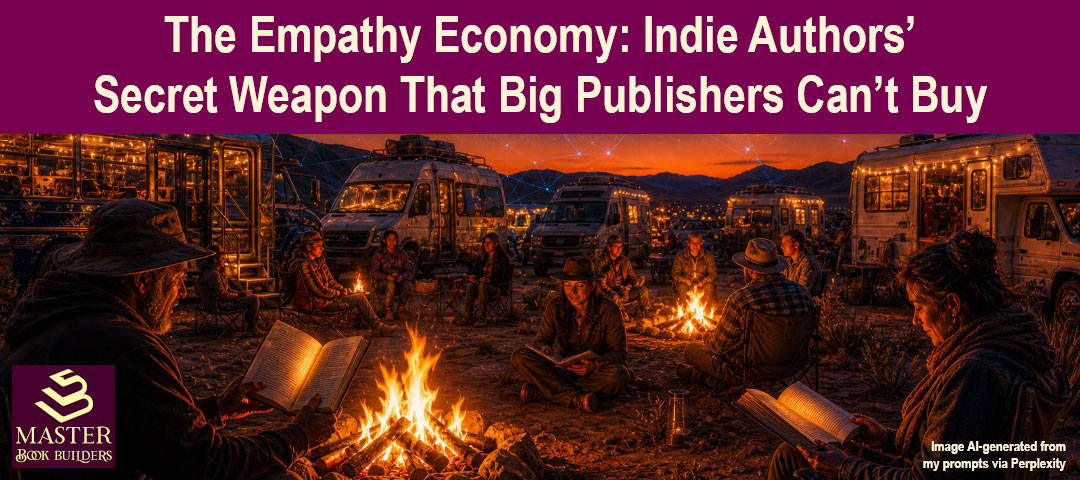
Oh, and the “reading around the campfires” background in the featured image at the top was generated by Perplexity. I cropped the original and added the text, logo, and “AI-generated” disclosure in Photoshop.
I’ve previously discussed other ethical uses of AI in my post about the Authors Guild’s new “Human Authored” certification and our own “Human Authored, Edited, and Designed” variation. It’s okay to use AI for spelling and grammar checking, to generate front or back matter (like the table of contents, bibliography, or index), or for “researching, brainstorming, outlining, or any purposes other than generating text.”
Just don’t let the AI write your book. Or articles. Or social media posts. The research shows your readers can tell. They may cut you some slack if you disclose some piece was AI-generated. But that’s not the human to human connection that pays off in the empathy economy.
Building an Author’s Empathy Economy Network
As an indie author you have a structural advantage over traditional publishers that better enables you to take advantage of the empathy economy. You don’t have corporate layers (or lawyers) between you and your readers. You can reply directly and promptly to an email or social media message. You can share the messy parts of the writing and publishing process. You can pivot on a dime to change this week’s newsletter topic in response to a reader’s question or concern.
And heck, as a writer, empathy is already your super power. You build characters and whole worlds in your fiction. You create personas for illustrative stories or recount real human events in your nonfiction. You bare your soul in your memoir. You get this.
A 2025 NetGalley report titled “Why Empathy is the Future of Consumer Marketing in Publishing” recognized:
“Readers aren’t just here for the books — they’re looking for an experience that resonates with them on a deeper level.”
While the report advises “publishers” to use this truth to “design marketing campaigns that feel personal,” indie authors can go directly to their readers and actually deliver that feeling in all their interactions.
Here are three steps you can take right away to apply these principles in your book marketing efforts:
1. Rethink your success metrics. In the empathy economy the currency is acts of kindness and the metrics are how your words and actions benefit others and make them feel. As I put it in another post, you should adopt a “recognize and reward” mindset in which you acknowledge and respond to readers, making them feel seen. And then, as relationships grow, find ways to reward them with freebies, behind the scenes info, and exclusive access to you and your work.
2. Show your work. By this I mean let your audience in on how much effort goes into your writing, how many moments of fear and doubt you’ve felt, the false starts, wrong turns, as well as the small victories and joy along the way. People respond to authenticity and vulnerability with empathy.
3. Treat other authors as collaborators, not competitors. Be quick to recommend another author’s work, even if — maybe especially if — they write in the same genre. Find ways to collaborate on book signing events, online webinars or summits, book giveaways or package deals. Readers will always be looking for their next read, after they finish your latest book. Help them while you’re writing your next one. Chances are the other author and the reader will take note of your kindness and then karma will take its course.
The real life experience in the Arizona desert, backed up by the research, shows that empathy economies are both theoretically viable and already functioning among us. How will you take advantage of these realities?
As a closing thought, I’ve focused on the benefits of the empathy economy concept for indie authors, but the more I researched and wrote, the more I realized that empathy elevates relationships in any person to person marketing situation. Most sources discussed above were not, after all, looking at book publishing.
And just as important, applying the concepts discussed above gives the same advantage over large corporate entities to any solopreneur, freelancer, coach, or consultant who is willing to build their empathy capital in their target market by engaging with kindness and generosity.



Leave a Reply