

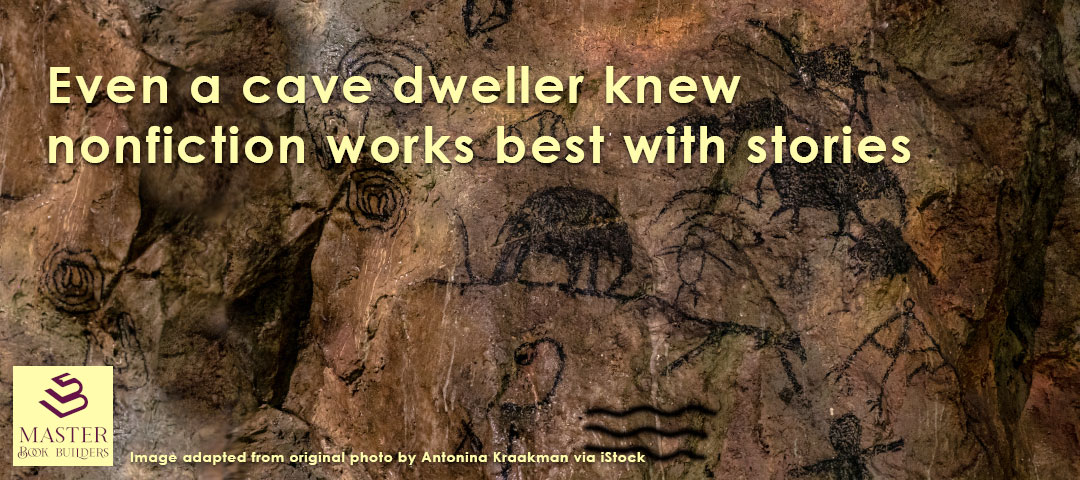
Even a Cave Dweller Knew Nonfiction Works Best with Stories
 We’ve mentioned that Yvonne and I are working on another book together called Bleeding on the Nonfiction Page: How to Bring the Magic of Story to Your Nonfiction Book.
The latest draft opens with a story about Deenah, a young woman in paleolithic times, who discovers a herd in a valley she’d never seen before, the terror she faced getting back to the cave, and how she solved the problems of remembering and communicating vital details to her clan.
Cave Art as “Proto-writing”
This story about Deenah’s experience draws on what we know about the origins of storytelling, as well as the function of the earliest methods of capturing and recording them. Crucial to our purpose in the upcoming book, recent evidence suggests that human storytelling with symbolic representations began in nonfiction.
Archeologists studying cave art have long focused on the large pictures of animals, humans, and objects — often ascribing religious meanings to them, an approach called “shamanism.” More recent studies, however, have examined the non-figurative or geometric signs that accompany many of those works: dots, circles, rectangles, crosses, wavy lines, and more. Paleoanthropologist Genevieve von Petzinger has cataloged 32 signs that appear in caves all over Europe, with some found all over the world.
She visited 52 cave sites and studied hundreds of records of others and wrote,
“For there to be this much continuity between sites, I realized that our ancient ancestors had to have a system in place.”
Among the signs she identified were those wavy lines, which may have represented a river and possibly had a map-like function.
A 2023 paper in the Cambridge Archaeological Journal examined the pairing of lines, dots, and Y-shaped figures with animal pictures and argues that they represent a kind of lunar calendar to track when different animals typically give birth. Others point to cave drawings with multiple animal and human pictures as telling stories of successful hunts, conveying important information regardless of any spiritual or religious overlay.
The authors were careful not to claim that these signs, or their use, amount to writing. The signs do not form an alphabet. Instead, von Petzinger labels the system she identified as “proto-writing.” But the point remains that humans used symbols to record information and convey narratives, alongside their spoken words, for tens of thousands of years before true writing systems emerged, as the title of a February 2026 article in Science Daily confirms:
“40,000-year-old signs show humans were recording information long before writing.”
Fiction in Nonfiction
And those earliest symbolic efforts appear to have come in the form of nonfiction — accounts of hunts, maps, calendars. The reason seems obvious: just as they had long needed to share useful information orally and accurately, and remember it, when they hit upon recording it externally on cave walls and tally sticks, the need for truthful, accurate, and, most of all, memorable ways to represent it remained.
Since the hunters couldn’t carry the cave wall with them on the hunt, the important details had to be easy to recall. Another study of hunter-gatherers in the present examined the function and evolution of storytelling and concluded, “one of the adaptive functions of storytelling among hunter gatherers may be to organize cooperation.”
Millennia of oral storytelling experience would have taught the value of stories as memory devices, long before modern neuroscience confirmed it. Thus, the artistic representations of animals, action scenes, and accompanying symbols needed to perform the same roles as a talented bard.
Another point about storytelling in nonfiction that may explain the long fixation with the shamanist interpretations of cave art is that a story does not need to be literally true to convey an important truth. Metaphor, parable, allegory, fictionalized accounts of real events, even legend and myth, can carry your nonfiction message. As B. Navarun recently put it on LinkedIn, “stories may have operational truth in addition to descriptive truth.”
One of my all-time favorite study titles, “The Fiction that Fiction is Fiction,” by Michelle Sugiyama, opens with the quote,
“All tribal myths are true, for a given value of ‘true’.”
— Terry Pratchett
Again, long oral traditions would make this second nature to Paleolithic nonfiction “authors” like Deenah. If it’s not already, we think you should work on making it second nature to you, too.






3 Comments
Leave your reply.