

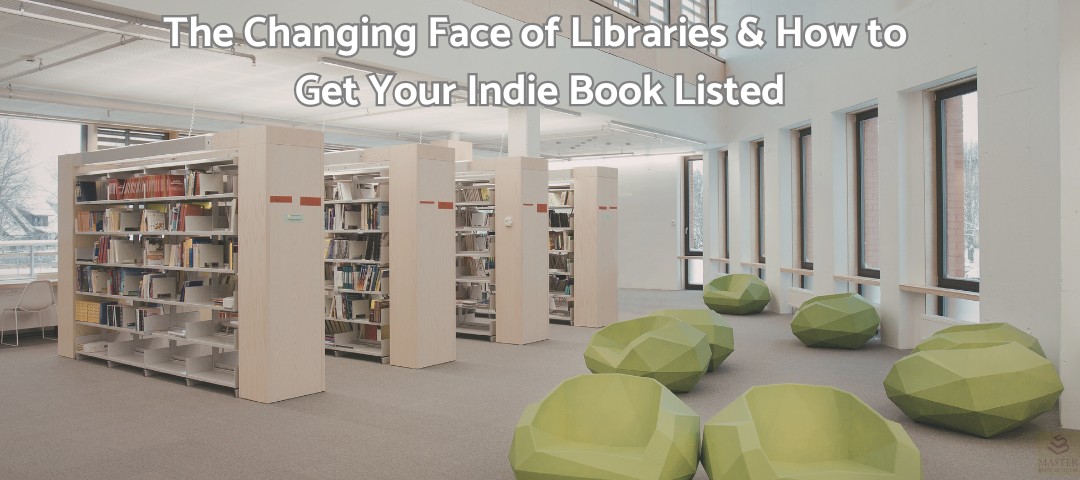
The Changing Face of Libraries & How to Get Your Indie Book Listed
Authors who self-publish often forget or ignore one of the most powerful places on the planet to have their book noticed. That’s in a library.
I know, many of you have thought about libraries, but you despair because you’re afraid of rejection. I have felt your pain. But it’s time to rethink libraries.
Last week, a good friend of mine on LinkedIn – haven’t I told you to be on LinkedIn? You meet the smartest people there. – talked about the library of the future and introduced me to something new that I knew I had to pass along to you.
Gillian Whitney, a business book coach and visibility strategist, wrote an entire post about libraries. In her post, she introduced Bibliotech public libraries. A first, and so far only, all-digital public library (that I know of, if you know different, please share in the comments).
Based in Texas, this organization is working to:
“Provide all Bexar County residents with technology access to enhance education and literacy, promote reading as recreation, and equip all members of our community with the necessary tools to thrive as citizens of the digital age.”
On their Resources page, they list a group of places they pull their content from. Of particular interest are NoveList and CloudLibrary. These are a couple of the places BiblioTech gathers its titles from. Both are worth checking out today.
While BiblioTech serves a specific community, it accepts books from all over. The site provides instructions for uploading your book and, as Gillian says in her LinkedIn post, “When you upload your book to BiblioTech, it becomes accessible to ANY Texas library.”
She also notes that the folks at BiblioTech can help you get your book into the right format if you need help with that.
The Library of Tomorrow Has Arrived Today
Libraries are in the business of providing reading material for their communities. Over the years, they’ve learned to reinvent themselves and how they do their work, as readers changed the way they read.
Today, because so many people read on their Kindles and other digital devices, many librarians know they must keep up by providing books in whatever format their visitors want. Ebooks keep the library viable as an option for readers who might not come in to check out a physical book. This also serves the greater community who can’t make it into the library to check out books. Offering ebooks just makes stories of all kinds available to everyone.
Personally, I, like so many others I know, prefer that print book. In Colorado, the library was just down the road from us. Tom and I would go there and check out books on a weekly basis. The library also had meeting rooms, comfortable outdoor seating, and lovely corner areas where you could curl up to read your book and just let the day go by.
But today, a lot of people prefer digital. If you’re one of them, then you understand. If you’re not, it pays to pay attention anyway.
Here’s how you get your books into other libraries, after you’ve visited BiblioTech: (I had help from ChatGPT in compiling this list, but I added and rewrote a lot of what I got from that AI tool, as I always do. Still, I want folks to know, AI isn’t bad in generating outlines.)

Step 1: Make your book easy to order
Libraries order books from specific places. For print, it means having your book available through a library-friendly distributor like Ingram.
For ebooks and audiobooks, you want your title distributed to platforms libraries use—such as OverDrive, Bibliotheca, or through an aggregator like Draft2Digital, Smashwords, or PublishDrive. Remember to be very specific with your metadata (ISBN, categories, description, BISAC codes, pricing). Read this blog post, 18 Valuable Insights for Indie Published Authors, which includes metadata advice.
Step 2: Package your book like a pro
Librarians are looking for good books. If you have a great story or a powerful message, but your book looks amateurish, they will pass on it. As mentioned in many other posts here on the Master Book Builder blog, you should invest in a professional cover that enhances your book and presents a great first impression. Your interior formatting should represent the book’s genre and be easy to read.
Next, you want to have an error-free description that grabs the reader’s attention right away – that first sentence is a hook. Make it work for you. Also, make sure your imprint name and publisher information look professional; libraries treat you as the publisher of record, so live up to that title. If you’re pitching a print book along with your ebook, think about durability: standard trim sizes, decent paper, and quality binding all matter more in a library than in a single‑read retail sale.
Step 3: Research and respect your librarian
Every library system has its own policies for handling indie-published books, and some have specific local‑author submission guidelines. As with any marketing, you want to check the library’s website for “local author,” “self-published,” or “materials selection” pages.
You may find that they accept donations (why would you donate your book? To get it seen!), require review copies, or ask you to submit via a form. If possible, find out who is in charge of your genre, and this includes literary fiction, which is its own thing. Some librarians may only handle children’s and YA. Others may handle adult fiction and nonfiction. You need to have your conversation with the right person to get results.
Step 4: Send a short, friendly pitch
As with any connection you make to libraries or independent bookstores or to Barnes & Noble, keep your pitch short, factual, and respectful of their time. Think of it as a professional cover letter, not a sales blast. Include:
- A concise description of your book (2–3 sentences) with audience and age/grade level if relevant.
- Key data: title, author name, publisher/imprint, ISBN, format(s), price, and distributor (e.g., “Available through Ingram”).
- Any social proof that matters to selectors: trade/industry reviews, strong local interest, awards, notable blurbs, or evidence of demand (e.g., local events or book club interest).
- A clear, low‑pressure ask, such as: “If you feel it would be a good fit for your [genre/age] collection, it is available to order through Ingram under ISBN __________.”
Avoid attachments unless guidelines specifically request them. Instead, link to your website, a one-page sell sheet, or a review page. Here’s where you need that website or webpage. Have you read Tom’s blog post about this? Here it is: 7 Essentials of Author Websites.
Step 5: Leverage being a local author and highlight your events
Many libraries have commitments to serving local authors and communities. If you’re local, highlight that right up front—this alone can move you from “maybe” to “very likely.” Ask whether the library has:
*** A local author collection or local history shelf where your book might fit.
*** Opportunities for author talks, book signings, workshops, or panel discussions tied to your topic or genre.
Showing up as a community partner—someone who offers value through events or education—often makes staff more inclined to support your work. In other words, be a friend to the library and the librarian.
Be visible in your community. If you’re holding a book signing at a café close to the library you are hoping to be listed in, mention that.
And word of mouth works. The more people who ask the librarian about your book, the better.
If you have a celebrity endorsement or a local endorsement, it’s all better. Use it.
This is where a sell sheet could come in handy. That one-pager can give the librarian all the information she needs at a glance when you stop in and introduce yourself in person.
I do recommend that. You may communicate via email, but try to visit as many local libraries as possible. Seeing your face and hearing you talk about your book could nudge you from a ‘maybe’ to a ‘yes.’
Step 6: Think long-term relationships, not one-off sales
Getting into one library is great; building relationships with librarians is better. Be a friend to your local library and librarian.
The power of being in library databases cannot be overstated. Here are just a few:
One: Your book is available in keyword searches all over the world – the online library doesn’t only serve a few folks in your neighborhood, it’s global.
Two: If someone is finding it hard to sleep and needs a good book, they can log on to their library website and search for one. Your metadata would count big time here.
Three: Readers can read at will. In other words, they choose the time, place, and instance for their reading. Yes, this is somewhat the same as print books, but digital books accessed through the library are so much easier to take with you on a trip or when you’re waiting at the DMV.
Four: No printing costs. Does this spell the end of print books? Hardly. In fact, these Goodreads comments on print and digital show that people still order and buy both, but also that ebooks are growing in popularity due to price and ease of use.
Five: Librarians can measure the popularity of books digitally, which is often easier than with print books.
Six: Ebooks take up less space, and they don’t use up trees; they’re friendly to the environment.
Librarians Are Definitely Keeping Up with the Times
In the American Libraries Magazine, an article from 2015 (Solving the Self-published Puzzle) shows that adding your ebook to a library database is becoming easier and easier to do. Because the librarians are in tune with the benefits of this book publishing channel.
Here’s what one librarian said in the article,
“Building collections
“Libraries are taking a variety of approaches to add local self-published books to their collections. One relatively common one is a partnership with an ebook self-publishing platform. That’s the approach MCL took when it launched the Library Writers Project in September, after hearing about a project Seattle Public Library did with the Smashwords platform last fall. Through December 31, MCL will accept submissions from local self-published authors to be considered for inclusion in the library’s collection. Submissions must be ebooks available through Smashwords.
“With print, we’d have a lot of issues with staff time and number of copies, but those aren’t considerations in the electronic space,” Ferris says. It also simplifies purchasing: Smashwords has a partnership with OverDrive, the library’s ebook vendor, so the acquisition process is the same as for other ebooks.”
I hope I’ve given you something to consider. Having a digital copy of your book available for readers who prefer that format isn’t hard. The benefits outweigh any troubles you might have in creating it.
Because digital is so much less work for the librarian, as outlined in my article, I recommend you add libraries and ‘how to get into my library’ into your marketing plan somewhere at the very top.
One article I read talked about libraries becoming media entertainment centers where people are editing podcasts, exploring virtual reality, creating videos, and making movies. Think of it – your book could be a movie adapted by teens in your local area.
I want to close with this interesting quote from Smart Brief, “With new purpose: libraries become multi-use anchors,” a great read about the changing face of libraries. This is thought-provoking and gives me hope that libraries will always be around. I know some communities are losing their libraries, but for the most part, libraries are still hanging in there, providing even more services to their local communities.
“The American Library Association is working to reinvent its profession, just as librarians always have. Libraries began as book-lending circles in taverns. In the late 1800s and into the 1920s, they offered education where schools couldn’t. During World War II, libraries fostered discussions about democracy and supported voter registration campaigns. However, its latest reincarnation may be its greatest challenge.
“Creating a community-centered library requires a significant shift in theory and practice, including internal strategy about staffing, policies and priorities. The shift doesn’t happen overnight or by accident. It must be deliberate, be intentional and have dedicated resources to be successful,” wrote librarians Erica Freudenberger and Susan Hildreth in the 2021 ALA book Ask Listen Empower: Grounding your library work in community engagement.”
If you’ve been successful in getting your book into libraries, share your story in the comments.
If you’ve put libraries on the back burner of your marketing, I hope this article convinces you to bring them back to the top of your list.

Leave a Reply