

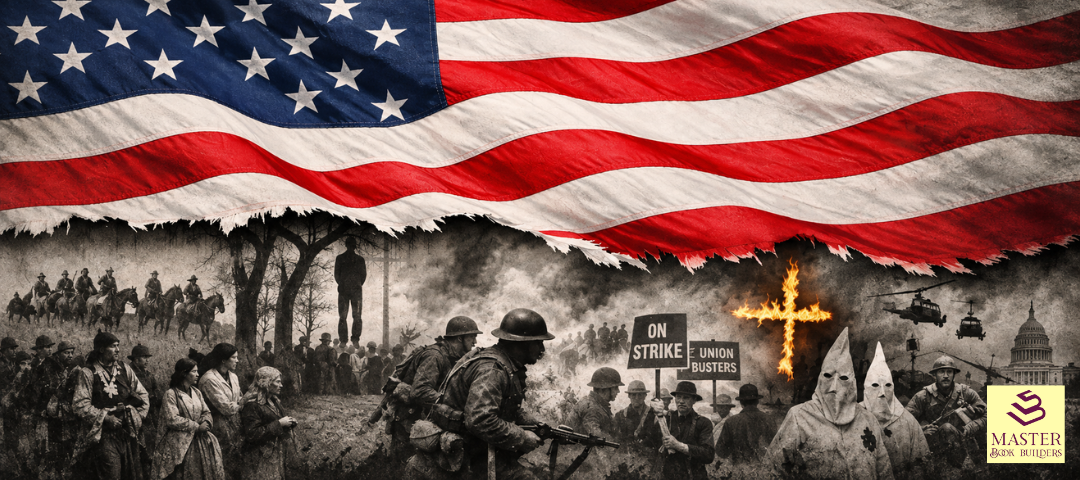
America doesn’t have a history problem.
It has a mass-produced ignorance problem.
It has a truth problem.
That is the argument at the center of A True History of the United States by Daniel A. Sjursen. Sjursen is less interested in simply retelling American history than in showing how the version many Americans learned became so sanitized, heroic, inevitable, and reassuring in the first place.
From the opening chapters, Sjursen pushes back on the idea that Americans simply forgot the more uncomfortable parts of their history. He argues that the version many were taught was shaped to celebrate national progress while minimizing or omitting Indigenous displacement, slavery, racial violence, labor exploitation, and imperial expansion.

For anyone whose understanding of U.S. history was built around progress, American exceptionalism, and a mostly heroic view of the country’s past, Sjursen presents a very different account.
Sjursen, a historian and former U.S. Army officer, examines some of the country’s most deeply rooted national narratives, especially American exceptionalism. He traces recurring patterns across different periods of American history and supports those connections with the events and policies he documents.
Throughout the book, Sjursen examines Indigenous displacement and violence, slavery, racial hierarchy, economic exploitation, labor conflict, territorial expansion, war, and American imperial power. He does not treat these as unfortunate side notes to an otherwise uncomplicated national success story. He shows how land seizure, forced labor, racial hierarchy, military expansion, and concentrated economic power helped shape the country’s growth and institutions.
It is easy to admit that terrible things happened in American history. It is harder to consider Sjursen’s argument that many of those events were not isolated failures, but part of the political, economic, and social systems that shaped the country.
Again and again, Sjursen shows a familiar pattern: force is used to acquire land, labor, wealth, or political control; institutions benefit from that power; and later historical narratives recast the outcome as justified, necessary, or inevitable.
American History and the Patterns We Repeat
Much of what Sjursen describes does not feel confined to the past. It feels uncomfortably current.
Debates over voting access, policing, war, public education, censorship, protest, race, and the teaching of history make the patterns Sjursen traces especially relevant now. His account raises a difficult question: what happens when a country deals with the consequences of its history without fully confronting the systems, policies, and power structures that produced them?
Systems built around exclusion, unequal power, and control do not simply disappear when the laws or language around them change.
Sjursen repeatedly shows how decisions about land, race, labor, political power, and war continue to shape laws, institutions, political rhetoric, education, and national memory.
In that sense, one of the book’s central concerns is national amnesia. A country cannot learn from what it refuses to remember honestly.
American Exceptionalism and National Memory
Sjursen repeatedly connects national identity to the version of history a country chooses to preserve.
When difficult history is softened in the name of patriotism, education can become less about understanding what happened and more about protecting a preferred national image.
American exceptionalism is central to that argument.
Sjursen is not arguing that the United States is uniquely evil. His point is that it is subject to the same ambitions, prejudices, economic interests, and struggles for power that have shaped other countries and empires.
Exceptionalism can discourage scrutiny when protecting the country’s image becomes more important than examining its history.
A fuller account of American history is often treated as criticism of the country itself. Discussions of racism, colonialism, imperialism, exploitation, or state violence can quickly become arguments about whether someone is “anti-American.”
Understanding the country’s institutions requires acknowledging how they developed.
Accountability does not require rejecting the country as a whole. It requires placing historical truth above the need to preserve a heroic version of the national story.
A True History of the United States is not anti-American. It is anti-lie.

Sjursen challenges the idea that caring about the country requires accepting a sanitized version of its history. His focus is on the violence, exploitation, and excluded voices that traditional accounts have often pushed to the margins.
The larger question is not simply what Americans know about their history, but why some parts have received far more attention than others.
American history should not be taught primarily to preserve a comforting image of the country.
It should include the events, systems, and voices that have too often been minimized, omitted, or ignored. Only then can we learn from our history and not simply repeat it.




Leave a Reply