

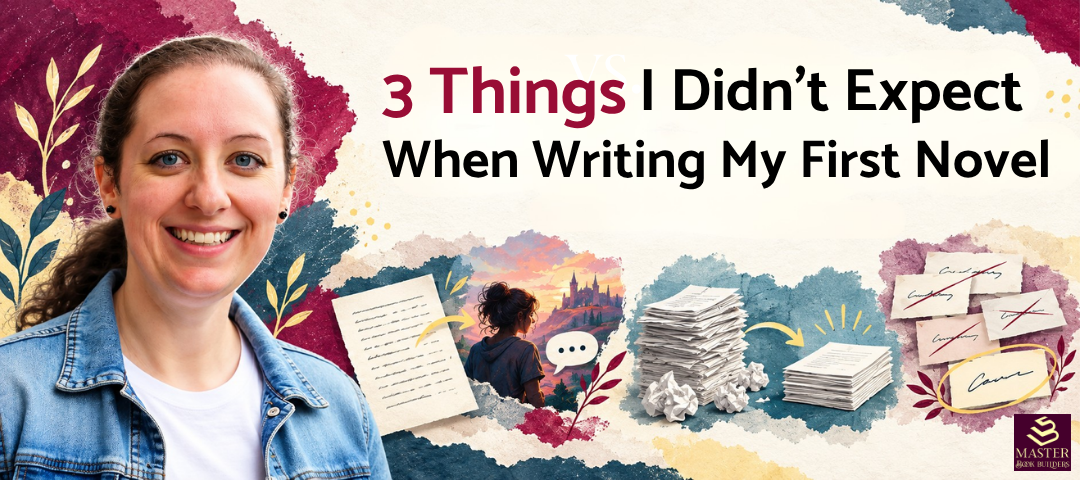
Writing and independently publishing Breaking Kylie was quite the adventure! There was plenty of excitement, a steep learning curve, the occasional urge to throw my computer at the wall, and a few moments when I looked at my husband and said, “I don’t think I’m ever going to finish this book.”
But I did!
After more than two years of writing, editing, revising, and second-guessing myself, Breaking Kylie became a published novel. And while the cover design, formatting, distribution, marketing, and everything else involved in independently publishing a book are a whole other story, today I’m focusing on the writing and editing process.
I expected plot changes, character development challenges, and plenty of late nights at my computer, eyes drooping as I stared at the same sentence for thirty minutes straight. What I didn’t expect was just how many headaches certain parts of writing and editing would give me!
Show vs. Tell (Wait… There’s a Difference?)
When I first started working with Yvonne DiVita, my developmental editor and Master Book Builder Extraordinaire (who definitely had her work cut out for her!), my manuscript was over 170,000 words and 500 pages.
Yes, you read that correctly. Five hundred pages.
I’d spent countless hours developing characters, writing dialogue, and building the world of Breaking Kylie. And I was feeling pretty proud of myself!
Then Yvonne started reading.
One of the first things she pointed out was that I was doing way too much telling and not nearly enough showing.
My reaction? I’m sorry, what does that even mean?
I’d spent years reading books without ever giving much thought to the difference between showing and telling. As a reader, I understood what characters were feeling without really thinking about how the author made that happen. Yvonne explained that readers don’t need every emotion spelled out for them. Sometimes, it’s better to let a character’s actions and dialogue speak for themselves and allow readers to figure out what the character is feeling.

Instead of simply telling readers Kylie was angry, I could show it through a sarcastic remark, her refusal to answer a question, or the way she walked away from an argument.
And suddenly, it clicked!
Of course, understanding the concept and actually putting it into practice were two very different things.
During editing, I started noticing places where I’d spelled out emotions that the dialogue or actions had already made clear. Other times, I’d written entire paragraphs about something I could have conveyed in just a sentence or two.
It took several rounds of editing before I really started getting the hang of it. And when Yvonne told me that even experienced writers struggle with show vs. tell, well, that made me feel a whole lot better!
I also learned that telling isn’t necessarily a bad thing. Sometimes, a little explanation is all readers need to keep the story moving. The tricky part is figuring out when to show and when to tell.
I had to learn to trust my readers a little more and resist the urge to explain every little thing. Turns out, sometimes less really is more!
And if you’re struggling with show vs. tell, too, cut yourself some slack. Even the pros are still working on it.
Cutting Scenes (But I Love That Part!)
Remember that 500-page manuscript?
Yeah, let’s just say Yvonne and I had plenty of editing ahead of us!
Cutting scenes wasn’t nearly as easy as I thought it would be, especially when I’d spent an entire afternoon perfecting a conversation, developing a character, or writing a scene I absolutely loved.
I’d poured so much time and emotion into Breaking Kylie that cutting scenes felt personal.
So, when Yvonne suggested cutting a scene, my first reaction was usually, What do you know?
Turns out, quite a lot!
The problem wasn’t necessarily that those scenes were poorly written. Some were funny, others were emotional, and a few helped me understand the characters better. There was even dialogue I struggled to let go of.

But when Yvonne asked me to step back and look at the bigger picture, I realized that not every scene was moving the story forward. Sometimes, a scene repeated information readers already knew. Other times, it slowed the pacing or distracted from something more important. And occasionally, I had to admit I wanted to keep a scene simply because I enjoyed writing it or because it meant something to me, even if it didn’t necessarily add anything to the reader’s experience.
As the author, I knew far more about Kylie and the other characters than readers would ever need to know. I’d imagined conversations, explored backstories, and developed relationships that never made it into the final story.
Those details helped me develop the story, but that didn’t mean readers needed to know all of them.
I didn’t always agree with Yvonne right away, either. Shocking, I know.
Sometimes, I’d push back and explain why I thought a scene mattered. She would consider my reasoning, and sometimes she’d agree it should stay. Other times, I’d step away, reread the scene later, and realize she had a point.
By the time Yvonne and I finished editing, Breaking Kylie had gone from over 170,000 words to around 107,000. More than 60,000 words cut! And trust me, letting go of those words wasn’t easy.
But the good news? Deleted scenes don’t have to disappear forever!
They can live happily in another folder, where I can occasionally revisit them and remember just how brilliant I thought they were.
Chapter Titles (Why Was This So Hard?)
One thing I never expected to struggle with while writing was choosing chapter titles.
Seriously, who knew something so simple could cause such a headache?
I’d spent so much time thinking about the plot, characters, pacing, dialogue, and how all the storylines would come together.
Chapter titles? Not exactly at the top of my list.
I figured I’d deal with those later.
Well, later arrived, and suddenly I was questioning everything.
Since Breaking Kylie is told from multiple points of view, should I use character names? Maybe quotes? Or skip titles altogether and save myself the trouble?
I wanted chapter titles that added something to the reading experience without giving too much away. A little intrigue, a hint of what was coming, or a healthy dose of Kylie’s sarcasm.
Sounds simple enough, right?
And so began a ridiculous amount of overthinking.
I’d come up with a title, love it, reread the chapter, question whether it really fit, and start all over again. Sometimes, I’d have several options to choose from. Other times, I’d look at a perfectly good chapter and have absolutely no idea what to call it.
I’d just sit there staring at the screen like someone had unplugged my brain, wondering how I’d managed to write an entire novel when I couldn’t even come up with one chapter title?
Eventually, I realized I didn’t need to overthink every single title. Some could be emotional, others more serious, and plenty could be funny or lighthearted.
Looking back, I’m happy I decided to include chapter titles. They added another layer of personality to Breaking Kylie, and I think they made the reading experience that much more fun.
And if you’re someone who can come up with chapter titles without agonizing over every single one, please teach me your ways!
Turns Out, I Had a lot to Learn
If there’s one thing I hope aspiring authors take away from my experience, it’s that you don’t need to have everything figured out before you start writing a book.

I certainly didn’t!
I started Breaking Kylie with a story I wanted to tell, characters I cared about, and a pretty good idea of where I wanted everything to go. What I didn’t realize was just how much I’d have to learn to turn it into a finished novel. One thing I can’t emphasize enough is the importance of hiring a professional developmental editor. If you’re writing a book, do not skip this step! Even if you’re an experienced writer or editor yourself, you need someone who can look at your story with fresh eyes. A developmental editor can help you spot issues with plot, pacing, character development, and story structure that you might be too close to recognize on your own.
Eventually, all those drafts, revisions, and lessons turned into a book I could actually hold in my hands.
Was it easy? Absolutely not.
Do I still have plenty to learn? You bet!
If you’ve been thinking about writing a book, I hope you’ll go for it! Don’t let the things you haven’t figured out yet stop you from getting started.
Believe me, you’ll learn plenty along the way. You’ll make mistakes, change your mind a hundred times, and probably wonder what you’ve gotten yourself into. But that’s all part of the process!
Everyone has a story to tell, and you never know who yours might reach or what it could mean to them.
About Breaking Kylie
Breaking Kylie by Kat Shaw is a young adult coming-of-age novel about identity, survival, complicated family relationships, and one girl’s fight to reclaim her life when the people closest to her are determined to define it for her.
Available now through Amazon and most major online book retailers in the U.S. and internationally in hardcover, paperback, and eBook.



Leave a Reply