

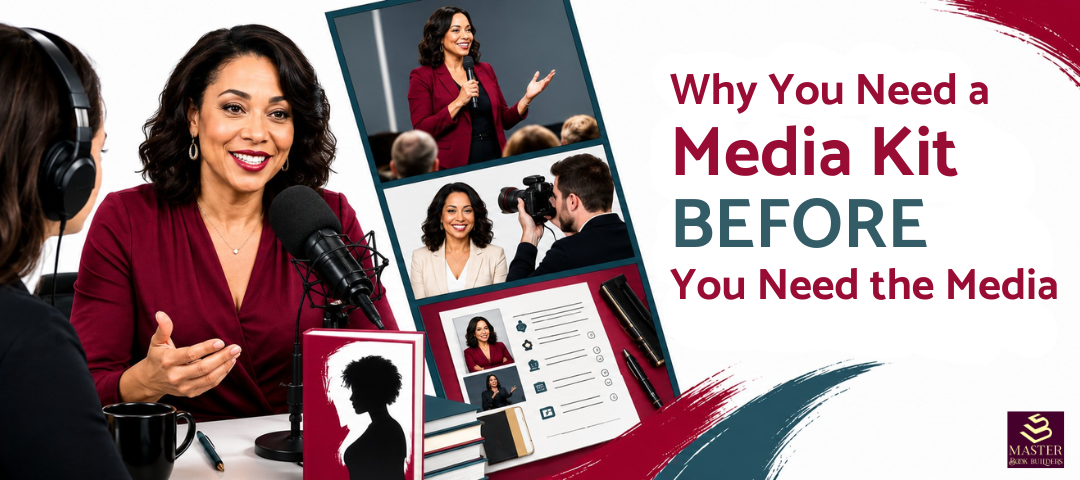
Why You Need a Media Kit BEFORE You Need the Media
The subject of media kits came up in conversation in a networking group I visit on Fridays.
This group was pretty savvy. They all knew they needed a media kit; they just weren’t sure how to create one.
In fact, many authors speculate that they ‘might need’ a media kit, without ever creating one. Those who finally understand the importance of a kit finish their book and then create the kit.
That’s wrong-headed thinking. It may surprise you to learn that you should actually begin creating your media kit before you write your book.
Why?
It’s easy: your media kit isn’t for you. It’s for people who want to interview you. It’s for – Tada! THE MEDIA!
Let’s go over what a media kit is.
A media kit is an organized list of information about you and your book. It’s one of the best ways to highlight who you are, what your book is about, and why you would be a good guest, interviewee, or speaker.
Media kits create a nice, ordered, easy to read professional introduction. Note: the kit may be two or three pages, depending on how it’s organized or outlined, but it’s not a book. Keep it short.
Looking at your book as a business, which we’ve talked about before, your media kit becomes part of your marketing materials. Having one:
💠 Saves Time
💠 Builds credibility
💠 Creates consistency
💠 Makes you look professional
💠 Gives people the right information to promote you accurately
Who is the media kit for?
Your media kit will become very valuable to these people:
⏺️ Podcast hosts
⏺️ Event planners (looking for speakers)
⏺️ Libraries
⏺️ Bookstores
⏺️ Bloggers
⏺️ Book clubs
⏺️ YouTubers
⏺️ LinkedIn Live Hosts
⏺️ Local news (TV and print – for those outlets that still have print)
⏺️ Radio DJs
⏺️ Television producers looking for your expertise
It’s not unthinkable to share your media kit with your Facebook followers or share it on your other social media accounts. These may be more personal contacts, but they are your network, and you never know who they might know that would be interested in interviewing you about your book.
What exactly goes into a media kit?
Build the media kit in two sections. An About You section and an About the Book section. (Reedsy also has some ideas on this.)
I want you to remember that you are in charge of your marketing (check out my blog post, “From Book Launch to Lifelong Buzz Marketing,” about that) and this is part of your marketing efforts.
About You:
✒️ You’ll need a short bio (50 words – remember to use third person. When being introduced, the host will say She or He or They, not ‘I’. If you use first person, you make them work harder to introduce you. Don’t do it.)
✒️ Medium bio (150 words – some hosts prefer more lengthy introductions)
✒️ Long bio (400 -500 words – often for keynoting)
✒️ Professional and personal photos (Share any images from speaking engagements; include something softer or more personal, such as hiking, if you hike. I have one of me sitting and reading a book)
✒️ Social media links – not just the @ symbol and your username. Give them the entire URL.
✒️Website
Contact Information (here’s hoping you have a professional email address – not Hotmail, or AOL, or even Gmail…though, if it’s your name on Gmail, as mine is, that’s okay; better if it’s related to your book, though).

About the Book
💠 3D image of your cover
💠 Book description – use the one from Amazon (if the book isn’t published yet, create one of your own now – you need to know how to speak about the book even before it’s published)
💠 A synopsis of the book – sometimes an annotated TOC can fit here, but ask if the host wants one first.
💠 Your photo holding the book
💠 Sample interview questions and how you might answer them
💠 Speaking topics – keep it to one or two. Don’t be all over the place. Be succinct.
💠 A discussion guide (similar to a reader’s guide which we talked about recently)
💠 Endorsements (again, if the book is not published, use testimonials about you or your business; or leave this off until you get endorsements)
💠 Awards (this will come after the book is published)
💠 Reviews (these will come after publication or beta reader feedback)
💠 In traditional publishing, you would include your publisher and publication date. You do not have to do this with Indie publishing.
Optional:
⏺️ Book trailer (a one- to two-minute video about the book, just like a movie trailer)
⏺️ Downloadable excerpt
⏺️ Sell sheet
I found some useful information about press kits (another name for your media kit) and sell sheets on the Smith Publicity page:
“The star of the show is, of course, your book. That’s where the sell sheet comes into play as a one-page document that lists information about your book cleanly and simply.”
Where do you put the media kit?
Don’t hide it! Don’t put it in a drop-down menu! Give it its own page on your website.
Oh, I am assuming you have a website. Or a web page for the book on your business website. If not, read Tom’s blog post on the 7 Essentials of Author Websites.
Your page should be easy to find. It should say “Press” or “Media Kit” or “Author Media Kit.”
If it’s buried six clicks deep, I won’t find it and neither will anyone else. If you’re recommended by a friend or colleague to any media, they will go to your website expecting a media kit, and if you make them search for it, you’ve lost valuable time to connect that you may never make up.
Yes, the media kit can be a downloadable PDF on that page. However, pull out some of the most important info to build the page. The page needs content, after all. Put images, your medium-length bio, maybe some “can’t wait for this book” comments from folks you’ve shared the book with, if you don’t yet have reviews and/or testimonials.
Make the page visually attractive and easy to read. Include a 3D image of the book, your photo, and a short book description. Then refer people to the full media kit for download.

If you’re smart…
Of course, you’re smart. But if you’re really smart, you’ll be composing this document well before your book is published.
Unfortunately, in my experience, most writers still think book first, marketing later.
To their detriment!
I urge you to start gathering material now! Our friends in traditional publishing at Penguin also offer some insight into marketing before publication here (the article is from our long-ago Covid-19 days, but still has good, quality advice). I especially liked #6 in their list – Get To Know Other Authors:
“In the stressful, yet remarkable leadup to your book’s on-sale date, no one else understands what you’re going through quite like another author does.”
Write your bios. Messy first drafts accepted! You can always go back and revise.
Hire a photographer or have your best friend take photos with her phone. Make sure they’re crisp and clear. They don’t have to be professional (although you will want some professional shots once the book is published). They have to be representative. So yes, clear, crisp, a true image of you and your book.
Create a list of speaking topics. And why you’re the right person to speak on them. This is your author message. Also, have a little side story about yourself that’s not in the media kit prepared. Something fun and interesting.
Gather those “can’t wait for this book!” comments until you can get real testimonials. If you know folks who can show enthusiasm for your book pre-publication and who represent the message or topic you’re writing about, that would be great.
Think about an FAQ series of questions that relate to your book’s topic.
Make a list of your beta readers and when you’ll contact them.
Start planning your launch.
For those of you who are already published and haven’t yet prepared your media kit, don’t panic. It’s okay. You can do it now. You now have all the pieces you need. Once you have it, mention it on social: “I just created my media kit!” Consider asking folks to review it and give you feedback.

As an Authorpreneur
Authors today aren’t just authors anymore. They’re authorpreneurs. That means your book is a business. Or, if you have a business, your book is part of that business.
I talk about this a good bit in this blog post: Your Book as a Business.
This means you probably have business cards. A website. Marketing materials. Social presence. Perhaps a blog. All meant to help market you. Now, as an author, you should also have a media kit.
Here are your action steps for this week:
➡️ Create a folder on your computer called Media Kit.
➡️ Write your first 50-word bio.
➡️ Write five interview questions.
➡️ Choose a photo you are proud to display.
➡️ Have all your social media in one place (with proper URLS).
➡️ Write a two- to five-sentence description of your book.
This is the start of your media kit. I do recommend that nonfiction authors, especially, be present on LinkedIn. This is where folks find you; your media kit is where they verify you. See my blog post about LinkedIn here: Why LinkedIn Matters.
I believe it’s so important for authors to understand this:
Having a media kit creates the Yes.
✔️ Yes, I want to interview you on my podcast.
✔️ Yes, I want to interview you about your book.
✔️ Yes, I want to invite you to speak.
✔️ Yes, I want to recommend you.
If you wait for the invitation to come, you’ll be scrambling to respond. With a ready-made media kit, your answer is as fast as a click and a “Thank you for requesting an interview. Here’s my media kit. Let me know what else you need.”
Last bit of advice
Your media kit is not a finished document. It’s fluid. It changes with each new speaking gig or interview you do.
Think of it this way:
➡️ Version 1: I’m writing a book.
➡️ Version 2: My book is published.
➡️ Version 3: I spoke here and here and here. I will be speaking here and here and here.
➡️ Version 4: My book won an award.
➡️ Version 5: I am writing book #2.
Updating your media kit is so important because you always want the freshest content ready for your media outlets. Remove any outdated images, links to interviews done years ago, and even revise your bio and book description on a regular basis.
This is your biggest job. Making sure your media kit is up to date, not something stale and boring from 5 years ago. Which means I need to go update mine today!
Any questions? I have a PDF checklist for anyone who wants it, which outlines what you need to include in your media kit. Email me – yvonne (at) yvonnedivita (dot) com.



Leave a Reply