

New Reasons for Indie Authors to Focus on Amazon and KDP
Instead of my email inbox, these tips arrived via my LinkedIn feed and in the IBPA Independent print magazine by snail mail.
Thinking of Abandoning Amazon? Think Again!
Our LinkedIn friend, Dianne Volek, is running a series discussing how authors who attempt to avoid selling their books on Amazon, for example by publishing on the IngramSpark platform, may be surprised to find it listed on Amazon anyway. That’s because the book goes into Ingram’s catalog and Amazon can list it for sale the same as Barnes & Noble, Bookshop.org, or any other book retailer.
Here I’m going to give you a quick summary of her Part 2, because it puts numbers to the simple fact that by choosing not to publish on Amazon’s own KDP platform, not only will your book likely still show up on Amazon, but you’ll make less in royalties on copies sold there.
And Amazon will make more!
Here’s why: If you publish your book via KDP, Amazon pays you a 60% royalty (minus printing cost) if your book is priced at $9.99 or more. Amazon gets 40%.
But if you publish via IngramSpark, Amazon becomes just another retail outlet and gets the suggested industry standard wholesale discount of 55%. You get 45% (minus printing cost).
How does that look in the real world?
Well, Dianne ran the numbers using KDP’s Help article for a 333 page paperback with a rounded print cost of $5.00 to show that for a book priced at $20.00, Amazon would get $8.00 on a book published via KDP. But if the same book were published via IngramSpark, with the 55% wholesale discount, Amazon as the retailer would get $11.00.
Of course, that also means the author would get more on a KDP book. Dianne calculated the author’s profit as $7.00 in her example. She didn’t do the comparative calculation for IngramSpark.
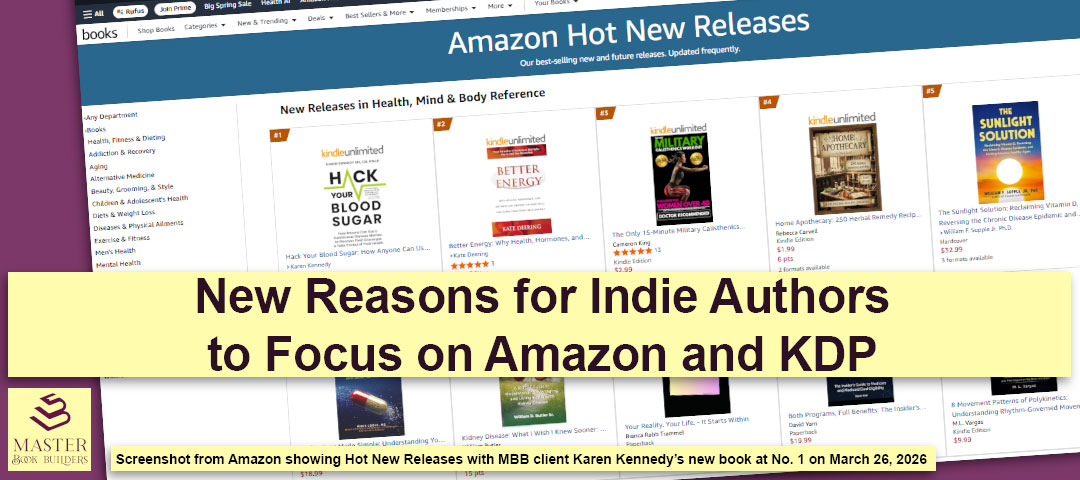
So I decided to use the publicly available calculators on both platforms (KDP’s and IngramSpark’s) with our client Karen Kennedy’s new book, Hack Your Blood Sugar: How Anyone Can Use a Continuous Glucose Monitor to Discover Their Glucotype & Take Control of Their Health. [See if you can guess why I’m using her book with the link to Amazon; “hint” in the section below about the A10 update.]
Again, using the details about the book straight from the Amazon sales page (page count, trim size, etc.), here’s what the calculators show:
Book published via KDP, sold on Amazon (60% royalty, minus print cost):
- List price: $24.95
- Print Cost: $4.66
- Estimated Royalty: $10.31
Book published via IngramSpark, sold on Amazon (55% wholesale discount):
- List price: $24.95
- Print cost: $8.50
- Author compensation: $2.26
I grabbed a screenshot of the IngramSpark result, because I was so startled at the gap:

So, by avoiding KDP, Amazon still sells your book, but it gets more, and you get a lot less.
More Reasons Indie Authors Can Benefit:
Amazon’s “A10” Algorithm Update
On to the article by long-time friend in the book business, Penny Sansevieri, in the latest edition of the IBPA Independent Magazine (online article here), entitled “Amazon’s A10 Update Explained: What It Means for Indie Authors and Publishers.”
I’m going to give you just a couple of highlights, because I think you should read the whole thing.
The most important aspect of the A10 update is, as Penny describes it,
“it rewards the one thing AI-generated books can’t fake: Real author signals. Real reader engagement. Real credibility across the web.”
If that sounds a bit like Google’s original approach to search, she says that’s intentional, because:
“Amazon is battling the rise of low-quality, AI-generated books, protecting consumer trust …”
She identifies four major changes the A10 update brings to Amazon’s search algorithm to implement that goal of discovering quality books that are relevant to the customer’s request. The first one is huge:
“According to industry analysts, Amazon’s A10 update increased the weighting of external traffic by an estimated 20%-35%.”
That means your book gets elevated in Amazon’s search results when you send traffic from your website, your blog posts, your email newsletter, along with social media pages, podcast show notes, articles, interviews, and so on, that mention you and your book with a link to Amazon. The idea is for Amazon to be able to tell that you are real, you wrote the book, and that other humans care about it.
Penny lists three more aspects to the A10 update: relevancy score, retail page quality, and your Author Central page. And she gives a four-step “A10 Playbook” with specific actions you should take.
We’ll be helping our clients implement theirs. Go read Penny’s article to get started on yours.
Author’s Choice
I know, there are lots of reasons to dislike Amazon. There’s a whole book on the subject, How to Resist Amazon and Why, by Danny Caine, which — ironically — you can buy on Amazon. In light of the numbers we ran above, it’s likely that he paid a hefty price for sticking to his convictions and choosing not to publish via KDP. But there his book is, selling on Amazon anyway.
Some may disagree, but it seems to us that in the book publishing world the choice is not whether to deal with Amazon, but how. You can read more about our reasons for choosing KDP when we re-entered the publishing space back in 2018 in my post, Which Big Dog Will You Choose for Your Book.
You may also note that many of the links to books in prior posts and elsewhere on our site go to Bookshop, not Amazon. That’s because when I heard about Bookshop’s mission to share some revenue with local independent bookstores (over $46,000,000 so far), I was all in, setting up my own virtual bookshop with recommended reading lists, though I confess it’s been a while since I updated them.
But in the end, we’re in business and with the A10 update discussed above, our obligation to our clients may force a rethinking of where to link to their books, at least.
Of course, it will be their choice where to publish and where to send traffic, with knowledge of how their decision may impact their sales, their profits, and their ranking in Amazon’s search algorithm.
How does all this affect your choices?

![featured image for blog post, [TfTi] Ya Think?!? 'Self-Publishing's Output and Influence Continue to Grow' by Tom Collins](https://masterbookbuilders.com/wp-content/uploads/2024/11/IndieAuthorInfluenceGrowing-300x200.jpg)

Leave a Reply