

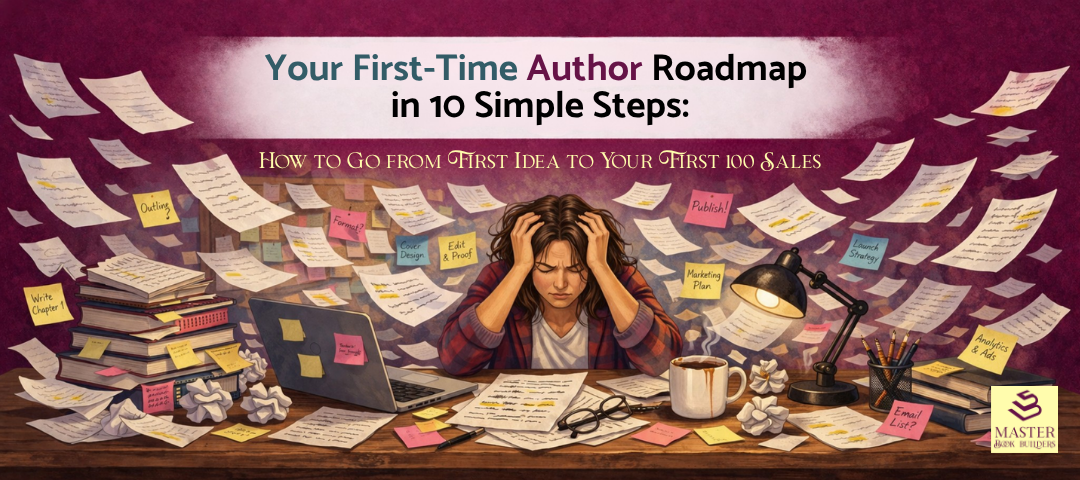
Your first‑time author roadmap in 10 simple steps: How to go from first idea to your first 100 sales.
Overwhelm is a frequent problem with professionals who want to write a book. I know that if you’re a busy professional with a book idea, you already have content you want to use, and/or you have chapters of your book simmering in your brain trying to get out. What you don’t have is a roadmap to show you how to get started and then how to understand what to do first, second, and next—without derailing the rest of your life.
I’ve created a simple, 10‑step roadmap to take you from “I think I have a book” to “My book is in the hands of my first 100 readers.” And by readers, I mean people beyond your beta readers (hop over to this link to learn more about beta readers), beyond your family and friends, and beyond the colleagues you work with. I’m talking about strangers. People who have been searching for your content, your book, your solution for years and years.
It’s time to give them that solution.
1. Clarify your “why”
Often, the ‘why’ is: I have a story to tell that could benefit others. Or this: Publish or perish is real. I need to write my book now!
Those are fine reasons. But they don’t speak to the deeper why. What do you want to happen once your book is published? What do you want it to do for you, and more importantly, for your readers? Before you begin writing that book, get clear on what you want it to do for your life or business and what it should do for people who read it.
Are you aiming for clients, credibility, legacy, or creative satisfaction? Is your message, your story, something valuable and important that’s missing from your industry right now? How will your words change anything? Include all the points you want readers to get from the book. It’s a product; treat it like one. Understanding your “why” will guide every decision that follows.
2. Choose one strong idea
I’ve said it before; I’ll say it again: You can’t ride two bicycles at once. I know you have a dozen good ideas muddling about in your head. So, do I. Most first‑time authors have several ideas competing for their attention. They are all important, but you cannot write about all of them at once. Instead, choose the one where you: know the topic well, can picture a specific reader, and can describe their “before and after” in a single sentence. Put the others in the refrigerator. Or the parking lot. Whichever analogy you prefer.
A good way to determine whether your idea is strong enough for a book is to hop over to Amazon and search for other books on the same topic. Don’t be worried if you find a lot of them. That’s a good thing. It means there’s a market for them. For you. And yes, you can compete with all those other authors. People want multiple voices and viewpoints. And yours may be just the one they’ve been searching for, for a long time. Maybe they’ve been ‘settling’ for those other books.
3. Define your reader and promise
Ah! The ideal reader. Who is she? What does he want? What do they need? I recommend creating several avatars, not just one. Don’t create too many. Create three. Focus on: who they are, what they struggle with, and what they need to change in their lives, relevant to your book lives. What do they dream about happening, regarding your book’s topic? What keeps them up at night?
If you’re unsure of the answers to any of these questions, ask. Ask your newsletter subscribers. Ask your followers on LinkedIn. Ask people in your networking groups. People will be happy to share their insights with you. It’s what people do.
Once you’ve asked and answered those questions, complete this sentence: “After reading my book, my reader will be able to…” What? Be better at beekeeping? Complete a marathon without pain? Build a stronger, more prosperous business? Keep it concrete and practical.
4. Map the book (don’t just start typing)
I know many writers can just sit down at their computer and start writing. Clack, clack, clack go the keys on the keyboard. But let me tell you this, even those writers have to stop at some point and create an outline.
I recommend that you start with your outline. Sketch a simple framework. In our book, The How to Write a Book Book: Your Step-by-Step Plans for Bringing BIG IDEAS to Life One Page at a Time, we compared writing a book to building a house. To do so, you start with your foundation. It must support all the other parts.
This is your outline. List your main sections, tentative chapter titles, and 3–5 bullet points under each. This doesn’t need to be perfect; it just keeps you from wandering in circles and losing steam. You can tap into AI for this. “I want to write a book about <topic> and need an outline. Here are the main points I will be making <list them>. The book should be about 200 pages. Here are some books that are similar to what I’m talking about. Mine will be different because <tell it why>, so keep that in mind.” You will then revise and reword what the AI gives you. You may even have a lengthy conversation about the outline, always giving it specific prompts to ensure results.

5. Design a realistic writing routine
Create a workspace to write in. A quiet space. Our friend Stephen King, a fiction writer, is correct in his description of your writing space. This applies to fiction and nonfiction. King advocates for “a dedicated, distraction-free, and consistent writing workspace, centered on a quiet room with a closed door to signify ‘business.” Note the “closed door” advice. If you cannot dedicate a room to write in, with a door that closes, write in a space that other family members will respect as yours alone.
Also, choose the best time for writing. A time that works day-to-day. Yes, you’re busy. This is not going to be easy. If it were easy, everyone would do it. The truth is, a 2021 ThriftBooks survey showed that more than half of us want to write a book. But only 15% of us start, and only 6% get halfway through. For you to be one of the few writers who finish and publish a book, you need to get serious about when you’re going to write. Maybe you start slow—say, 30 minutes five times a week—rather than believing you can pound out your book on weekends. Consistency beats intensity, especially for first‑time authors.
6. Draft fast, edit later
Get that messy first version on the page! You’re not an editor. Even if you are, don’t edit yourself as you write. Let the words flow. Polishing every sentence is a waste of valuable time. Finish what you can and let your AI tool fix spelling errors where it can. Don’t rely on it to do all your spell checking, however. It’s a machine. It can’t know or understand what your specific words or phrases mean, all the time. It certainly can’t understand the emotional response you want from your reader.
I once created a funny ebook titled: 13 Excuses NOT to Finish Your Book This Year. Chapter 3 was: “You’re Too Busy Perfecting Chapter 1.”
“When you write, you need time to pause and contemplate. I get it. You want to give the words their due. You have me there. I’m a broken record when it comes to saying words matter. Using the right word, in the right place, for the right effect, as Mark Twain advises, is key to sharing the right message in your book.
“The difference between the almost right word and the right word is really a large matter. ’Tis the difference between the lightning bug and the lightning.” ~ Mark Twain
“So, if that means it might take years and years to complete your book, well, won’t it be stellar when it’s done!”
The answer is no. It will be sorry and outdated. Write now. Edit later. (Yes, I know there are some folks who take 10 years to write a book; so be it, for them. Try not to be them.)
7. Get smart feedback before publishing
This is where your beta readers come in. Revisit the link shared above in the introduction to this post. Beta readers should be people who are connected to the topic. People who will benefit from the book’s message. Not all books are for all beta readers. Try to find 10 – 20 people to share their thoughts with you.
You’ll be sending them an UNCORRECTED galley. It’s a proof of the book. As such, readers should be advised not to focus on typos or commas or missing quotation marks. Their job is to read the galley and offer insight into how well it has accomplished your goal. You will ask them to answer specific questions, such as: “Where did you get confused?” “Were there places I could have given more explanation?” “Did the stories resonate?” Vague “Do you like it?” questions won’t help you revise.
8. Be prepared to revise
Some books need more revision than others. Don’t be discouraged if your readers come back with issues, suggestions, and questions. That’s good. Some issues will be resolvable, others not so much. Suggestions from your readers are to be taken with a grain of salt. You and your editor will decide which suggestions to take and which ones to ignore.
When you revise, do so in layers. First, fix the big stuff—structure, flow, missing pieces. It’s hoped there won’t be much wrong in these areas. But if multiple readers cite issues, you must address them. After the flow and such, refine paragraphs and sentences.
Proofreading happens last. Trying to fix everything at once is exhausting; working in phases, focusing on one area at a time, is calmer and far more effective.
9. Know your publishing process
Before you reach the end of your book, you should have already decided which publishing path to follow. Understand that with traditional publishing, you’ll need to send out a proposal to an agent first. This should happen while you’re writing the book, well in advance of completing it.
Traditional publishers often want a hand in how you put the book together, and whether you need all the chapters you think you need. They make all the major decisions about your book, including cover design and interior design layout. And when it comes to copyright, though you own it, you grant them an exclusive (pay attention to that word) license to publish and they will grab all subsidiary rights they can convince you to give up. You can negotiate audio and overseas rights, but that requires hiring a lawyer. Working with a traditional publisher, authors are paid a 7% to 10% royalty (10% is high, but it happens) on all sales, after the publisher recoups their money from any advance they gave the author. Oh, and it could take up to 2 or 3 years before your book is published.
In hybrid publishing, you work with a publishing company that handles your editing, design, proofreading, and may offer marketing as an add-on. You pay a fee up-front for these services, and the publishing firm typically owns your ISBN. They also take a small share of royalties. Make sure to research this option. Many new authors have been burned by unethical or misleading companies that promise more than they deliver. Read your contract carefully! Look for reviews online. Ask to speak to some current customers.
When you choose independent (indie) publishing, you are the master of your fate. You are the project manager of your book’s success. You will assemble a team to work with you to ensure the book is written, designed, and formatted correctly. Often, with this option, there are service companies like Master Book Builders that will help you create your Kindle account and Author Central profile, too. Being in charge can seem daunting. Where do you find the right team? How do you manage them? I think these are questions to consider before you even start your book.
When authors want a one-size-fits-all solution that gets them from their words to the final published book, we’re here for them. Yes, we tailor everything to the individual author, but we offer just about everything you need to be a successful author. And we’re not alone. There are other service companies that offer similar services. Just not with the same amount of personal attention we offer.
Yes, indie publishing comes with a fee. Authors pay a fee for the expertise, the knowledge, and the personal attention they get with Indie publishing companies. It pays to understand exactly what you’re getting and how it fits in with your goals for your book. Companies like Master Book Builders do not own your ISBN, any copyrights, or collect royalties.
You might want to visit Tom’s post from January 2023, Weighing the investment in your book: Indie, Hybrid, or Traditional Publishing.
Each path has trade‑offs in control, assistance, speed, and support. No matter which path you choose, do your homework and read contracts or agreements carefully. It’s best to make this decision well before you get deep into finishing the book, choosing your cover design, and choosing your formatting and distribution, so your efforts line up with your strategy.
10. Finding your first 100 sales (readers)
Readers are like gold. Each one is important. Your beta readers count here, so choose them carefully. And reward them with thanks and chocolate. Well, chocolate or signed copies of your book. Ask them which they prefer.
However, we want those first 100 sales to be more than beta readers. We want to see those sales turn up in your KDP account as soon as possible. Did you know that the average author sells about 500 books? That’s over the lifetime of the book! Don’t be an average author.
Learn how to promote your book, your message, and yourself during the writing of the book. Talk it up on LinkedIn. Create promotions for both Amazon and Facebook. Offer discounts for bulk sales. At the Nonfiction Authors Association, they have a marvelous list of places to achieve bulk sales. I’ll share a few here but go to the link above and check the whole list.
Large corporations can distribute your books at their events or tradeshows. Instead of a coffee mug, pen, or other boring promotional item, they can give away your books!
Companies can distribute books to their customers or employees. When the book Who Moved My Cheese gained popularity, companies all over the U.S. bought thousands of copies to distribute to employees in an effort to help them embrace change.
Co-brand your book with a non-profit by adding their logo to your cover, and have their corporate sponsor purchase copies to distribute to members.
Remember to ask event planners where you will be speaking (and you should be speaking a lot!) if they will buy case quantities of your book for all the attendees. Or allow you to sell author copies in the back of the room, at a discounted price off the retail price online.
By preparing these options ahead of publication, you’ll gain your first 100 readers in no time!
I’m sure you have questions. Pop them in a comment below. Or message me on LinkedIn.





Leave a Reply