

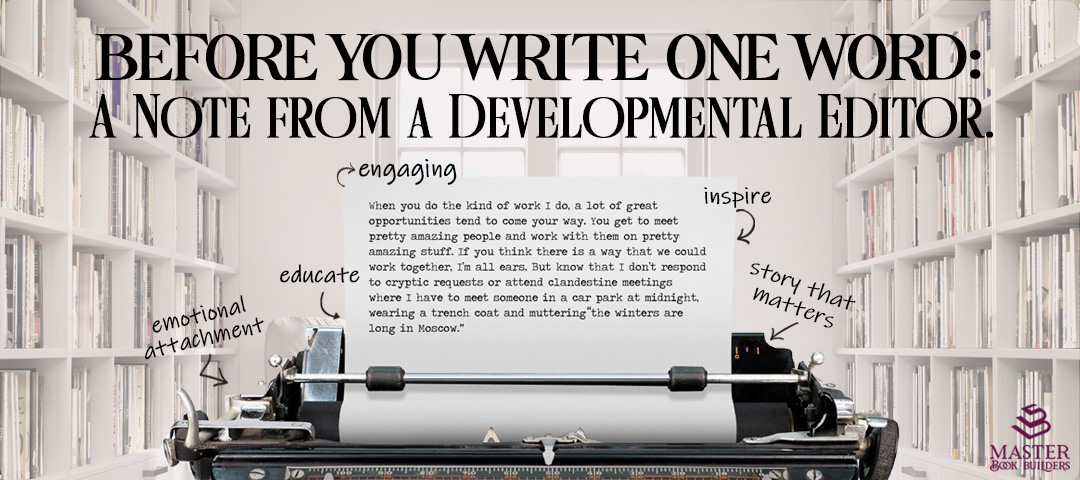
Before You Write One Word: A Note from a Developmental Editor
I know you have an idea.
You have a message.
You might even have a lot of LinkedIn posts that reflect your message.
It’s possible you’re keeping a journal.
You might be sharing your ideas in a blog.
All with the intent of writing and publishing a book someday.
I’m here to tell you that the moment you decide, really decide, to write your book is the moment you should be talking with a developmental editor.
Some of us work on completed manuscripts. I admire that. It takes a different skill to take the already completed ‘book’ and shape the story, finesse with the tone, and make sure the throughline is consistent.
I prefer working with authors who are just getting their idea down on paper (so to speak) and want the guidance of someone who can look at it from a third-party perspective. I’m the someone who helps organize the chapters. I ensure the stories are believable, emotional, engaging, and perhaps inspirational, which is always better achieved while the book is being written.
It’s like watching a baby go from infant to one year of age. The change is dramatic. Walking, talking, learning to understand names of things, completely immersed in their mother’s and father’s voices. The change between a baby that is totally dependent on others for everything and a toddler who can point, ask, or get things for themselves is dramatic, if you think about it.
Just as dramatic is a book that starts with an idea, which grows into a message, which becomes a purpose, and all the while, the author, the parent of said book, is there watching marvelous things unfold – as if by magic.
Purpose and Power
At Master Book Builders, we often say that excellence in publishing starts long before the words hit the page. And nowhere is that truer than in developmental editing—the earliest, most strategic phase of book creation. It’s where ideas are molded, messages sharpened, and structure crafted to carry your voice with purpose and power.
I think it’s the difference between a book that reads like a PowerPoint presentation, with too many strange images flying in right and left, too many bullet points, too many headings and subheadings, and not enough emotion in the story to pull it all together.
What you want is a book that builds authority, creates connections, leaves the reader with an emotional attachment to you and the book, and stays on their mind long after the last page is turned.
That’s enough of a chore in fiction, but in nonfiction it can be an even bigger challenge.
With nonfiction, you are writing something that should be more than just a telling of your story. The best nonfiction books don’t just tell us about you…
-They educate.
-They inspire.
-And most of all, they entertain by using fiction elements like these:
- Setting the scene
- Dialogue
- Character development
- Use of a protagonist and an antagonist
- A mentor
- A hero and a visionary
To make all of that happen, to support your voice, with your tone, to create stories that are believable and trustworthy and authentic, you need a developmental editor from the very beginning.

Why Storytelling Should Be a Strategic Plan in Nonfiction
Story is not reserved for novels, fantasy, crime tales, or memoirs. Story is part of the human condition.
I wrote to a friend this week and told her of some struggles I’ve been having with my health, and she wrote back, “You make it sound like a story.”
I consider that quite a compliment. What she meant was that I didn’t just say, “This is what’s wrong and here’s what’s happening.”
I told her how I’d been frustrated with my doctor and found another one, and how hard the transition was.
I made her feel my pain.
A few of the most influential nonfiction books in recent years—Atomic Habits by James Clear, Dare to Lead by Brené Brown, The 5 Second Rule by Mel Robbins—do the same. They don’t just share information. They use narrative to create emotional momentum. We learn from them because they show us their inner soul. They share stories about good things and bad things, and they relate to us as human beings.
They layer insight with story so that readers don’t just learn something, they feel something.
James Clear, for instance, opens his mega-bestseller Atomic Habits not with a framework or a bullet-point list, but with a personal story of being hit in the face with a baseball bat at age 15. That story becomes a metaphor for recovery, identity, and small wins—a thread that ties his habit-building philosophy together.
That’s storytelling as scaffolding.
And it’s what elevates information into impact.
The Developmental Editor’s Role: Not Just Editing – Architecting
Most people think of editing as fixing sentences. Making things “sound better.” And yes, sentence-level work is important—but not at first.
As a developmental editor, I am looking at and listening to (yes, I hear the words in my head) the way the story unfolds and flows. I am the reader, and as such, I want clarity, truth, a sense of humanity, stories that speak to me and relate to me. I want to feel that the author gets me. That the book, according to the blurb and the cover, will live up to its promise.
I am not, at that moment, worrying about commas, or verbs, or adverbs. For me, it’s the idea space—shaping the arc of your argument, the rhythm of your insight, and the structure of your storytelling. I want your content, all those words on all those pages, to have movement—so that each chapter builds on the last, that every section earns its place, and that the reader always knows where they are and why it matters.
Developmental editors ask the hard questions before readers do:
- What’s the throughline of this book?
- Who is the audience, the right audience?
- Is this book going to change their lives?
- Is the personal story you’re telling essential, or self-indulgent?
- Are you sharing too much context and not enough clarity?
- What do you want the reader to do after finishing the book?
It’s strategic. It’s iterative. It’s creative.
And it’s essential.
James McCabe, a strategic storytelling expert who frequently shares his insights on LinkedIn, writes:
“The masters of nonfiction don’t just report on their expertise—they build a narrative bridge between the reader’s problem and their own experience. That’s what a good story does. It leads.”
I think that this is where a lot of nonfiction falters. It tries to instruct before it connects.
It’s my job as a developmental editor to make sure that never happens.
What Authors Don’t See on Their Own
We’ve all heard the saying, “If you’re inside the bottle, you can’t read the label,” or versions like it. I first learned that phrase and its meaning in my early days of blogging. It was when I read Guerrilla Marketing by Jay Conrad Levinson.
It means you don’t know what you don’t know. And you don’t know what people who are reading the label know because you’re stuck inside the bottle. To know anything, you have to ask. Ask the people who matter.
In other words, you know your message, but not always how it lands.
That’s why writing without developmental support can feel like circling in a fog. You write, and revise, and write again. But something still feels…off. The chapters don’t flow. The tone shifts. The reader gets lost.
You’re stuck in the forest. And you can’t see the forest for the trees. Another great platitude that works here. If you’re wandering through that forest, you can be sure the reader will be, too. You may wander for a long time because it’s your book and you have to get it done! The reader will wander less. They will just put the book down and not pick it back up again (let us also hope they don’t preach to their social media friends about how confusing it was!).
In my work, I sometimes see:
- Books that lack organization because the idea was never fully mapped out
- Brilliant stories buried three chapters too late
- Chapters that repeat the same idea in slightly different clothes
- Powerful experiences that need trimming, framing, or anchoring in a bigger message
None of this is a failure. It’s just what happens when you’re writing all alone, without the benefit of outside help.
With developmental editing, I help you nurture the baby, clothe the baby, watch the baby start to eat by itself, take its first steps, become independent, and finally, laugh out loud at one of its own jokes. The baby becomes the story that you wrote.

Good Books (Real Books) Take Time. Successful Books (Real Books) Take Teamwork.
We don’t promise 90-day books. We don’t offer authors a way to crank out a manuscript in a weekend retreat. And we don’t use AI to write books. Why? Because if you believe in what you’re doing and you want to make a difference in other people’s lives, then what you’re writing and how you write it matters.
We believe writing needs time for reflection and creative energy. It isn’t just about writing to an audience. It’s about understanding that audience and making sure your book speaks directly to them.
This allows you to clarify your brand and leave a lasting legacy.
This is why I feel strongly about working with a developmental editor. Someone who will challenge you and be there to brainstorm all parts of the book. In some ways, we’re strategists who help our authors write the right book for the right audience.
Your Story Deserves Its Best Frame
If you’re thinking about writing a book, don’t wait until you’ve finished a draft to bring in a developmental editor.
Let me, or another developmental editor, help you craft the book as you write it.
Together, we can achieve the best results for you, your book, and your audience.
Need help figuring out which big idea you have should become your first book? Contact us for a Book Idea Review—before the manuscript begins.
Because writing a book shouldn’t start with hitting keys on a keyboard.
It should start with vision.

1 Comment
Leave your reply.