

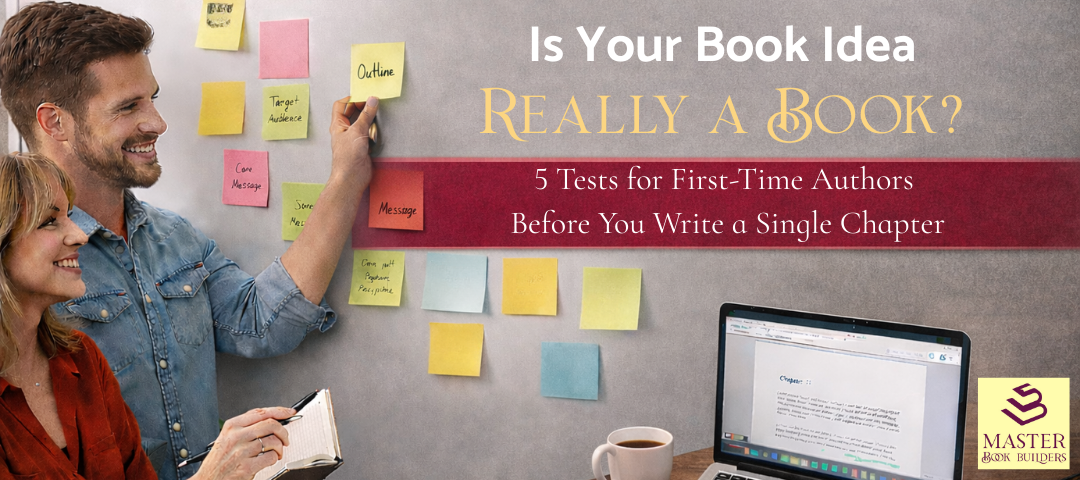
Is Your Book Idea Really a Book? 5 Tests for First‑Time Authors Before You Write a Single Chapter.
I think everyone should write a book. The world knows this. I say so on LinkedIn and in this blog on a regular basis.
But the truth is, writing doesn’t come naturally to everyone. In fact, too many people say they aren’t writing a book because they’re just not writers.
Well, most first-time authors I meet aren’t “bad at writing.” They graduated from fifth grade. They know how to put a sentence together. To create paragraphs. To convey an idea.
The problem isn’t the writing; the problem is that they’re trying to write a book before they actually have one.
▶️ Some folks have a 15-page ebook they think could be turned into a 200-page print book.
▶️ Some folks gather a group of their LinkedIn posts and think, there’s my book.
▶️ Or, they look at their blog posts, which they’ve poured so much energy and life into. And they think, I have a book here.
Unfortunately, in each of these cases, what they don’t have—yet—is a focused, book-shaped idea a reader can say yes to. They have a series of ideas. And yes, many times those ideas can be gathered into the premise for a book.
The problem is, ideas, plural, can get you into trouble. Without a core purpose or promise – a throughline as described in Tom’s blog post here – your many ideas will have the reader wandering around in a strange town without a map.
The Reedsy blog puts it this way:
When you start out, your idea is likely to be nebulous or vague, e.g., “It’s a self-help book for new parents.” Before you put pen to paper, you need to crystallize and tighten your original idea, as well as think about your target audience.
In 2023, I put it this way in my blog post, A Beginner’s Guide to Writing a Book:
Where is your content coming from? Your head? Your heart? Or your computer?
I offer you five simple tests today to help you determine whether your idea is really a book or needs a little more development first.
Test 1: The one-sentence promise
Try finishing this sentence in one breath:
“This book helps [specific reader] go from [starting point] to [ending point] by [how you will teach them].”
If you find yourself adding three “ands,” four audiences, or a mini TED Talk, go back and try again. Too much overthinking means you don’t have a clear book premise yet—you have raw material. That’s okay. We all have fantastic thoughts and ideas we want to turn into a business or a book, but to truly accomplish your goal of publishing a good book, not an average book, a good book, you need focus.
The book isn’t for you. It’s for the reader. So, go back and try the sentence again. As many times as you need.
Test 2: The “not for” test
Most first-time authors tell me their book is for everybody. Isn’t that nice? Once we agree it’s not for everybody, we narrow it down to two or three avatars, and we’re good.
However, what you should also understand who your book is not for.
For instance, our book, Bleeding On the Nonfiction Page: How to Bring the Magic of Story to Your Nonfiction Book (due out this summer), is not for novelists. Might they learn from it? Of course. But the book is for nonfiction authors.
Try this when you’re deciding who your book is not for:
- “This book is for new managers in tech—not C-suite leaders.”
- “This book is for women in midlife—not brand‑new college grads.”
- “This book is for people who already believe X—not for people I’d have to convince.”
Don’t fret about leaving people out or condensing your audience. It’s okay. In fact, it’s more than okay. It’s necessary.
Drawing these lines doesn’t make your readership smaller. It makes your book more findable and more useful.
IngramSpark’s guidance for first-time authors emphasizes this kind of focus:
…knowing your ideal reader and niche before you design, publish, or market the book.
Test 3: Your Initial TOC
Your TOC – table of contents – is the outline for writing your book. In my world, that first TOC is flexible and fluid. My authors know we can change the order of things at will.
Before you decide to take all those LinkedIn articles and blog posts and whatever else you’ve written and turn them into a book, try this exercise.
Take a notepad, a legal pad, whatever you have on hand, and sketch a rough table of contents on it. Just working titles, no perfection. For our purposes, we’ll assume your book is going to be 10-12 Chapters: (this does not include the foreword, the acknowledgments, the dedication, or your CTA)
- Introduction
- The big idea for the book
- Who needs to learn about the idea
- Where that reader is now in relation to the idea
- Why what they’ve tried isn’t working
- Why your experience will help them
- What you didn’t know that you know now
- Your core framework for success
- Implementing that success
- Advanced wrinkles/common problems
- Life after the transformation
- Conclusion
If you can’t fit a logical sequence into a simple outline like this, you probably don’t have a single book yet. You might have:
- Two or three books tangled together
- A course, a podcast, and a book all competing for space
- A mix of memoir, how-to, and manifesto that needs sorting
This is where a developmental editor can save you months of circular drafting: by helping you decide what belongs in this book and what belongs somewhere else.
I love this article at the Writing Cooperative, where Melinda Crowe describes how to outline a nonfiction book. She says many nonfiction books have between 12 and 15 chapters, so she chooses 13 as her target. In her article, she writes,
“The easiest way to whip through your initial outline is to treat it like a listicle. Write your working title; beneath that write your name — might as well claim ownership of this brilliant stuff right off the bat.
Skip a line, then write the word “Intro.”
Skip another line, then start a list of the thirteen most important things your reader needs to know about your topic. Don’t worry about writing anything under each list item yet. And don’t worry about the order of the topics yet. For now, just spill your thirteen bullet points onto the page.”
If you don’t know what a listicle is, hop over here to this MailChimp article on Listicles and learn more. This is something you can use for more than just a TOC.

Test 4: The “container” test (from dissertation or blog)
If you’re starting from a group of LinkedIn articles or a body of blog posts, your existing container probably doesn’t fit a trade book reader.
- LinkedIn articles are written to satisfy a small group of viewers – your book will need a much bigger audience.
- Blog posts are written to do exactly what this one is doing – provide insight into a specific topic.
The issue with both is that the content in each is not organized. Nor are these writings consecutive – in other words, we too often write whatever pleases us for that day, without thought of what we’re writing about tomorrow. Today it’s about the weather, tomorrow a recipe, the next day a rant about the LinkedIn algorithm. And the day after that, something more substantial.
What you end up with is a lot of great ideas floating about the web. Too many to make a book, without careful review and organization.
With one client at MBB, we took his dissertation and asked:
- What does your reader need to know from this research?
- What belongs in an appendix or a resource library instead of the main narrative?
- How can we turn dense sections into stories, examples, and clear steps?
With another client who had 50+ blog posts, we laid them all out, grouped them into themes, and discovered there were really 10 solid chapters hiding in the pile. Some posts merged, some expanded, and many were cut entirely—so the book could have a clean spine instead of feeling like a greatest‑hits album.
Ask yourself:
- If I stripped this down to 10–12 chapter-sized ideas, what would they be?
- What would a new reader need first, second, and third?
If you can answer those questions, your idea is much closer to being book-ready.
Test 5: The Three-Year Test
Imagine it’s three years from now. You’re still:
- Talking about this topic on podcasts
- Answering questions about it at events
- Being introduced as “the author of the book on X”
How does that feel in your body—exciting, neutral, or heavy?
A first book has a long tail. If you already feel tired of the topic, or if it doesn’t connect to the work you want to be doing, that’s a sign to refine the idea so it supports the life and business you’re building, not just the one you have today.
If these tests felt hard…
If you sailed through all five tasks, wonderful—start drafting, and consider bringing in a developmental editor at the onset. I know many developmental editors work on completed manuscripts, but I prefer to be there for the author from the first word to the last.
If you struggled with any of them, keep working at it. It means you need to refine and repurpose your idea before considering a book project.
Know that a good developmental editor or book coach will help you in a number of ways —not just to “fix” your pages, but to give you advice and guidance on:
- Deciding what book you’re really writing
- Shaping a clear promise and structure
- Making sure the book serves both your reader and your larger, long-term goals
Your idea might be closer to “real book” status than you think. Maybe it just needs the right shape.
For more reading on whether or not you and your idea are ready for a book project, read my recent blog post, 7 Questions to Ask Yourself Before You Hire an Editor, Hit Upload, or Start Marketing Your Book.


Leave a Reply