

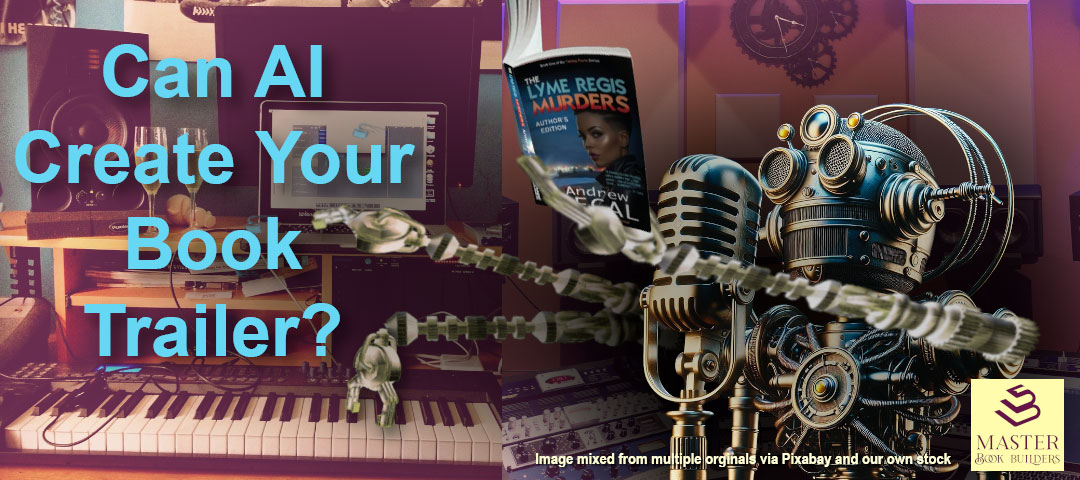
Can AI Create Your Book Trailer?
I’ve seen a lot of commentary about using AI tools to create book trailers, so I took a course.
Here’s what I’ve learned, or should I say confirmed? AI is not ready to produce finished work.
[As an aside, I just read an article predicting that one of the jobs for humans that’s being created by the growth of AI in the workplace is … drumroll … fixing the shoddy output of AI.]
During the trailer creation course, Descript was mentioned as one of the tools that could be used and we already have a account, so I decided to test the theory there.
But first …
Compared to what?
The whole point of using AI for creative (or any other) tasks is supposed to be efficiency, saving time and money, right? So to figure out whether we’re saving either, we need to recall what it takes to create a quality book trailer without AI.
Typical quotes for hiring a professional to create a book trailer range from $500 to $15,000 and up.
We charge in the lower third of that range, depending on the complexities of the project. But to understand why it can be expensive, you need to look at the work involved and the time that will require.
An article on Reedsy gives a good outline of the tasks:
- Identify you book hook
- Write a short, catchy script
- Assemble stock video and images
- Create a voiceover
- License the right music
- Edit it all together
- Finish with a call to action
Interestingly, the course I took recommended starting the first two of these tasks the old-fashioned way, by brainstorming and writing down keywords, themes, scene ideas, and so on, as preparation for entering a prompt into the AI tool. And because, without AI, these steps involve collaboration with our client, they generally consume at least a couple of hours of drafts and communication.
The same can be applied to each of the other steps, involving research, client feedback, and iteration. And number six, the editing part, may take several hours, with its own round(s) of feedback and polishing. As we’ll see below, this step is not avoided by using AI.
So, for comparison, it’s fair to say that creating a quality book trailer without AI assistance will take 10-20 hours of work, spread over several weeks, and cost hundreds, if not thousands, of dollars, if you hire someone to do it for you. If you want to do it yourself, remember that the savings on hiring a pro must be offset by the cost of the software and equipment you’ll need to produce a quality result.
My experiment
With all that in mind, I decided to set a strict limit on the time I would spend testing the AI methodology I’d learned. I chose two hours, which would show an 80%-90% saving of time over my estimate above.
Here’s what happened. I used a client’s book, Andrew Segal’s The Lyme Regis Murders, for the test. After some initial brainstorming, I entered this prompt into Descript’s new “Underlord” AI tool:
Create a video book trailer for The Lyme Regis Murders by Andrew Segal, which is Book One in the Tammy Pierre murder mystery thriller series. Use the cover image (attached) to set the mood and imagery and the Amazon book description (https://www.amazon.com/Lyme-Regis-Murders-Thriller-Thrillers-ebook/dp/B0F5X8CFW8/) to create the script for a 45-60 second video. I’m also attaching a mocked up “crime scene” image of the beach area where the three little girls’ bodies were found. Include some soft, sinister background music.
It took Underlord roughly five minutes to generate its first draft of the video. The script it came up with was not too bad, though I did some editing. Here’s the AI version:
Darkness falls on the quiet town of Lyme Regis.
Three little girls, gone. Their bodies discovered on the windswept beach.
Detective Tammy Pierre is called in—a brilliant investigator with a haunted past.
As the town reels in shock, Tammy must unravel a web of secrets, lies, and hidden motives.
Every clue leads her deeper into danger. Every answer brings more questions.
Can Tammy catch the killer before they strike again?
The Lyme Regis Murders—Book One in the Tammy Pierre murder mystery thriller series by Andrew Segal.
Available now. Dare to uncover the truth.
 By then I was nearly a half hour into the project. And frankly, the visual parts of the video were essentially unusable.
The image of the book cover was zoomed in to fill the width of the video, cutting off both the title at the top and the author’s name at the bottom. While I liked the zoom in, I didn’t want that to carry through the whole video.
I first attempted to get the AI to create a zoom-out effect. Underlord agreeably claimed to be able to do so. But several attempts produced no change in the video.
At that point, I had the AI delete the image entirely and reinsert it, which finally succeeded in getting the full cover to display.
With time elapsing, I chose not to attempt any further effects on it for now.
The crime scene image I had provided was omitted entirely in the first draft. And, conversely, when I asked the AI to place it at a certain part of the timeline, it was cropped into the portrait shape of the book cover, cutting off one of the investigators and most of the covered bodies.

It took me another ten minutes or so to get the AI to display that image fully.
In addition, no music was included, despite my instruction.
By the time I had gotten the AI to insert a music track, realized it was not at all the sinister kind I’d asked for and only played through the first couple of sentences, and also knew that I wanted to change the voice of the AI narrator, I only had about 20 minutes left in my self-imposed deadline.
That’s when I took over and made those last adjustments manually.
My conclusion
But what I had at that point was not at all the kind of finished, professional book trailer I would be happy about delivering to a client. I’d had no opportunity to think through and apply the timing adjustments I’d normally make. And I had expected the AI to pick up on the cover and crime scene images I’d provided and find several more images and stock video clips to ramp up the pacing and drama, as suggested in Step 3 of the Reedsy list above.
Here’s what two hours of work with Descript’s Underlord delivered (note that a cover slide is one of the missing elements I had no time to insert):
With the minimal tweaks I was able to make in my arbitrary two-hour window, I’d rate the trailer as barely usable for some social media marketing purposes. As many marketing folks have advised, an “okay” piece of marketing material is better than none at all. And social media audiences are generally receptive, or forgiving, about “homespun” looking video content.
Bottom line: You may save a bit of time on your scripting, using AI for a book trailer project, but not much else.
The course I took includes an entire lesson on manually tweaking the trailer in video editing software AFTER you’ve finished with the AI tool, and another lesson on adding marketing information in a closing slide — another item I didn’t get to, but kind of expected the AI to “know” about.
My advice: unless you have no budget and plenty of time and patience to learn and use your own video editing software, with or without AI’s help, hire a professional to give you a fully finished product.

Leave a Reply