
• Home
  • About
  • Your Book Done!
    • Nonfiction / Business
    • Audiobooks
    • Fiction
    • More Ways We Can Help
  • Sample Gallery
  • Blog
  • Podcast Videos
  • Contact Us
  • Terms of Service
  • Privacy Policy
  • Giving Back to Plant Trees
Get our newsletter and our free marketing eBook
Master Book BuildersMaster Book Builders
  • Home
  • About
    • Giving Back to Plant Trees
  • Your Book Done!
    • Nonfiction/Business
    • Audiobooks
    • Fiction
    • More Ways We Can Help
  • Portfolio
  • Blog
  • Podcast Videos
  • Our Books
  • Contact
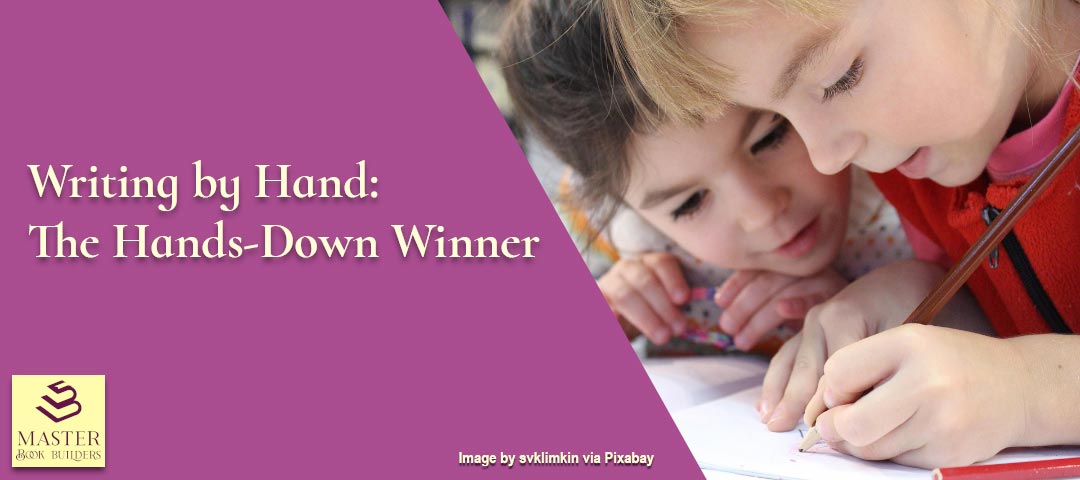
featured image showing girls writing intently with pencil for blog post, Writing by Hand: The Hands-Down Winner, by Tom Collins

Writing by Hand: The Hands-Down Winner

October 2, 2025 Posted by Tom Collins Learning, Reading, Writing

Writing by Hand: The Hands-Down Winner

We’ve talked recently in our BOSS Academy Phoenix Friday mastermind group about the value of writing by hand when engaging in self development activities like fleshing out the “why” of the work you do. Having stated to the group that there’s neuroscience research to back that up, I thought I’d review it briefly here.

Before diving in, two quick notes:

We tell anyone who’s in earshot the learning and support we get from our BOSS Academy colleagues, and founder Paul Kirch, has been key to our success. If you’d like a guest invitation to find out why, just let us know in a comment, or find us on LinkedIn.

Second, I fully recognize the irony of me sitting here typing this post. But I’m old enough that I did a lot of writing by hand from childhood through college, law school, and even my early days of law practice, when we still wrote first drafts of memos and briefs on yellow pads and handed them off to the typing pool. Astounding, I know.

Writing to Read

One of the most compelling findings is that writing by hand “is important for the early recruitment in letter processing of brain regions known to underlie successful reading.” The quote is from a 2014 study that compared preliterate, five-year old children who either wrote, typed, or traced letters and then were shown the letters while undergoing fMRI scans. The scans showed that the earlier self-generated printing of the letters resulted in activation of a wider variety of brain regions than either typing or tracing.

In the literature review section of that paper, the authors also noted earlier studies that found hand writing to be directly connected to the brain’s reading circuits in both children and adults.

Writing to Learn

A 2024 EEG study focused on areas of the brain that have been shown to be “crucial for memory formation and for encoding new information and, therefore, are beneficial for learning.” Researchers found:

“When writing by hand, brain connectivity patterns [across those areas] were far more elaborate than when typewriting on a keyboard …”

Writing to Remember

And a 2025 systematic review of existing research comparing hand writing to typing concluded:

“Handwriting activates a broader network of brain regions involved in motor, sensory, and cognitive processing, contributing to deeper learning, enhanced memory retention, and more effective engagement with written material. Typing, while more efficient and automated, engages fewer neural circuits, resulting in more passive cognitive engagement.”

While I no longer write out long form pieces by hand, I’m grateful that I learned to write that way, as it apparently helped me become a better reader.

And no, I’m not sitting here recommending that you write your book longhand — though I understand that a surprising number of successful, contemporary authors do. Stephen King has acknowledged experimenting with writing some of his books that way and is quoted as saying:

“It changed some things. Most of all, it made me slow down because it takes a long time … It made the rewriting process a lot more felicitous. It seemed to me that my first draft was more polished, just because it wasn’t possible to go so fast.”

But all this research does help convince me never to give up my habit of writing notes in the margins of books as I read. What better way to lock in what I’m learning, keeping track of the connections I notice with other books and ideas, and remembering the questions I often have about the text?

How often do you write by hand? For what purposes? Does the research inspire you to do more?

Share
0

About Tom Collins

Here at Master Book Builders, I'm known as the "Book Artisan" -- the guy who takes over to help with your book design and publishing steps, after you and Yvonne finish writing, editing, and polishing your book manuscript. As a writer myself, I usually chime in with a suggestion here or there. Since reading your book is inherent in my layout process, I bring that understanding of your message to your cover design, as well. And then I help with many of the tech and "author business" tasks in the publishing and marketing phases, constantly learning as the industry evolves. I try to share some of that learning in my blog posts, too.

You also might be interested in

A photo of a Black mother and child reading a book together. A quote about Black History Month books from the post, positioned next to the photo reads, "This is a month of celebration but also a month to contemplate the history of Black people in America. A history that is both beautiful and terrifying. Full of joy and laughter, and tears and sorrow. It seems best that we begin to learn more about it by reading."

BLACK HISTORY MONTH BOOKS: A Reading List for Your Bedside Stand … or anywhere else

Feb 8, 2023

Ailey is reared in the north in the City but spends summers in the small Georgia town of Chicasetta, where her mother’s family has lived since their ancestors arrived from Africa in bondage. From an early age, Ailey fights a battle for belonging that’s made all the more difficult by a hovering trauma, as well as the whispers of women—her mother, Belle, her sister, Lydia, and a maternal line reaching back two centuries—that urge Ailey to succeed in their stead.

An elderly white male-female couple sitting on a couch and hugging. Text over the image reads "A 100+ year life is about ... rejoicing in your age."

Wake Up To A Real 100+ Year Life

Feb 15, 2018

As someone who never expected to live to be 100, and who couldn’t have cared less, I am now pausing in my senior-hood and giving this idea a chance to grow in my consciousness. I don’t feel old yet (well, some days I do), and while I have a drawer in my night stand with my medication, only three are prescription.

Writing Lessons from HGTV Stars

Writing Lessons from HGTV Stars

Jun 28, 2020

Ever wonder what the HGTV home renovations stars could teach you about writing and publishing your book? Check these lessons in book building.

Leave a Reply Cancel Reply

Let's get in touch

Send me an email and I'll get back to you, as soon as possible.

Send Message

Recent Blog Posts

  • Is Your Book Idea Really a Book? 5 Tests for First‑Time Authors Before You Write a Single Chapter.
  • What Can a Virtual Book Tour Do for Indie Authors?
  • Are You Ready? 7 Questions to Ask Before You Hire an Editor, Hit Upload, Or Start Marketing Your Book.
  • Reading and Writing as Dementia Defense
  • [TfTi] Using TikTok as Your Bookseller
Tom Collins and Yvonne DiVita - Master Book Builders
  • Tom Collins & Yvonne DiVita
  • Master Book Builders

© 2005-2026 · MasterBookBuilders.com

  • Terms of Service
  • Privacy Policy
  • Contact Us
  • Home
Prev Next