

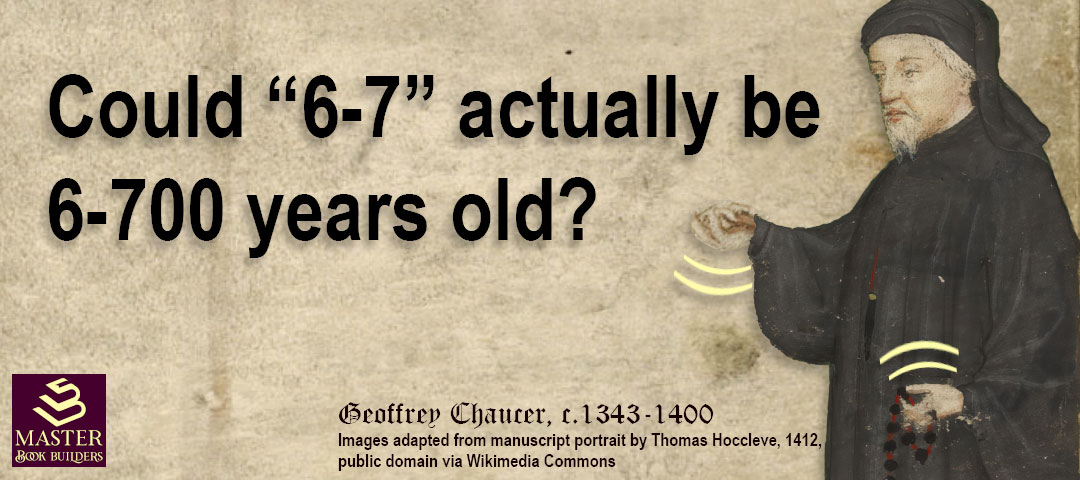
Marginalia: Could “6-7” actually be 6-700 years old?
Okay, the evidence for tracking 6-7 all the way back to Chaucer is, shall we say, circumstantial. But so is the evidence cited by Dictionary.com for the more recent origin of 6-7 as its Word of the Year 2025 — though I think they use the term “word” loosely in this case.
How did I get lured down this rabbit hole, you ask?
It started appropriately enough while reading a mystery novel, Leaving Everything Most Loved, by British author Jacqueline Winspear. Published in 2013, it’s part of the Maisie Dobbs detective series that’s set in England of the early 1930s. I came to a bit of dialogue where Maisie tells her boyfriend that her housekeeper “was at sixes and sevens.”
I’d never heard that phrase, but probably would have let it slide, as the meaning was reasonably clear from their earlier interaction with the housekeeper that day. Aware of the recent hubbub around Dictionary.com’s 6-7 announcement, however, I underlined the phrase, put a question mark in the margin, and later launched my own investigation to see if there could be any connection.
But first . . .
Where did “6-7” come from?
Dictionary.com wrote:
“The origin of this most modern use of 67 is thought to be a song called ‘Doot Doot (6 7)’ by Skrilla. … It was quickly reinforced by viral TikToks featuring basketball players and a young boy who will forevermore be known as the “6 7 Kid.” Within weeks, teachers were trading tips online about how to get their students to stop saying 6 7 all day long.”
Wikipedia says 6-7 as “an internet meme and slang term emerged in 2025 …” That could support the argument for the Skrilla song as its source, since the song was released on YouTube and Spotify in February 2025.
I ran into a problem with that logic, however, when I looked at the Dictionary.com graph purporting to show the growth in usage of the term starting with January 2025 and comparing it month by month to usage in 2024:

That made me wonder how much earlier I could trace the usage of 6-7, or six-seven. So I fired up Google’s Ngram Viewer and it spit out these graphs, tracing usage from 1800-2022 (where the current Ngram database ends):


It appears that you could argue for dramatic increases in usage beginning in 2000, or 1940, or even 1840!
But what does 6-7 mean?
Dictionary.com tells us,
“Some say it means ‘so-so,’ or ‘maybe this, maybe that,’ especially when paired with its signature hand gesture where both palms face up and move alternately up and down.”
We’re not told who “some” may be, but hold onto that one for when we get to “at sixes and sevens.”
In the end, Dictionary.com bails on giving any meaning to the term, with this:
“It’s meaningless, ubiquitous, and nonsensical. … Still, it remains meaningful to the people who use it because of the connection it fosters.”
Personally, if you can’t know what it means when you say it, or if you’re assigning your own meaning to it on the fly, leaving your listener to guess or assign their own meaning, I bet we can all think of more effective ways to foster meaningful connection.
Back to the origins mystery.
Evidence for another kind of connection
When I looked up that phrase “at sixes and sevens” the origin story went much farther back, all the way to Chaucer’s Troilus and Cresseyde from the mid-1380s. There he wrote:
“Let not this wretched woe gnaw at your heart,
But manly set the world on six and seven.”
The phrase is thought to derive from an early game of dice in which those were the riskiest numbers to bet on. In Chaucer’s usage, it meant to risk one’s entire fortune or life.
Shakespeare used a similar form in Richard II, around 1595:
“But time will not permit: all is uneven,
And every thing is left at six and seven”
By the late 1600s, the phrase had evolved into its current pluralized form and its meaning had shifted to, “a state of confusion and disorder.” Not such a stretch from confusion to maybe this, maybe that, eh?
And if we accept the idea that Skrilla’s “Doot Doot (6 7)” is at least part of the inspiration for the current meme, does that eliminate a connection to the older forms? Not necessarily.
In the first place, I don’t know Skrilla, but I’m not willing to assume he’s never been exposed to any of the past literature or music that have used the phrase at sixes and sevens, listed with quotations in this Wikipedia article:
- H.M.S. Pinafore, Gilbert & Sullivan (1878)
- The Outline of History, H. G. Wells (1919)
- Clouds of Witness, Dorothy L. Sayers (1926)
- The Skin of Our Teeth, Thornton Wilder (1942)
- The Collector, John Fowles (1963)
- Raoul and the Kings of Spain, Tears for Fears (1995)
More specifically, there are several relatively recent songs and albums that use the “sixes and sevens” form directly and that Skrilla could easily have come across. For that matter, others using the “6-7” form could have found and shortened the older version themselves.
All 6’s and 7’s, Tech N9ne (2011). According to the American rapper, the title of this album “means ‘in a state of confusion and disarray.'”
At Sixes and Sevens, Sirenia (2013), goth metal with a track of the same title; link goes to YouTube where you can listen.
Sixes and Sevens, John McKay (2025). The title of the first track, “Zen And The Art Of Nonsense,” would seem to play well with both the longstanding meaning of “at sixes and sevens” as a state of confusion and disarray and Dictionary.com’s assertion that “6-7” has no meaning.
I’ve been called a nerd. I proudly plead guilty. But hey, words and phrases are kind of our thing around here.
What do you think? Is there a plausible connection between Chaucer and the cool kids today?


Leave a Reply