

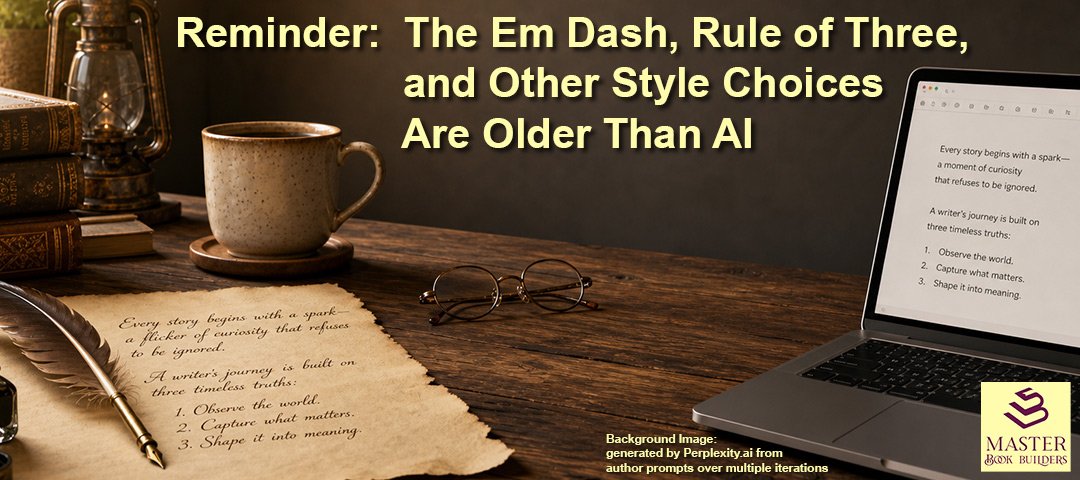
Reminder: The Em Dash, Rule of Three, and Other Style Choices Are Older than AI
Have the AI content police raided you yet?
I read an article recently in the Guardian about accusations that the short story winner of the Commonwealth prize was AI generated. The article quoted Ethan Mollick, a professor at Penn, as claiming that a “100% AI generated story just won the Commonwealth prize for the Caribbean region.” He cited an AI-detector as evidence, but also said, “Come on, if you know you know.”
The article went on:
“Another commentator … said there were ‘plenty of other obvious markers of AI writing’ in the story, including a litany of ‘not x, but y’ sentence structures, by now a familiar trope.”
We’ll get into these kinds of claims in a bit — like the notion that using my beloved em dash means AI wrote it — but first take note that claiming someone’s work is AI-generated can have life-altering consequences.
Career Ending Consequences?
The Guardian cites two glaring examples: A freelance journalist, Alex Preston, was fired by the NY Times for using AI to write a book review. After readers noticed similarities to an earlier review in The Guardian, the writer “confessed” to using AI in his piece, though outright plagiarism is less often mentioned as an AI tell.
The second example hits home for indie authors. Mia Ballard self-published her book, Shy Girl, in February 2025. It’s garnered over 5,000 ratings (avg. 3.4) and 2300 reviews on Goodreads. It was picked up by Hachette for a quick-turnaround UK release in November 2025, selling ~1,800 print copies, with a planned US release to follow.
A June 2025 report on The Bookseller (free registration required) was headlined,
“Wildfire snags rights to Mia Ballard’s ‘addictively gory’ horror novel.”
Hachette’s editor who acquired Shy Girl for its Wildfire imprint said at the time:
“If you’re into gory horror and razor-sharp revenge thrillers that keep cranking up the tension, Shy Girl is your next obsession. Packed with gasp-out-loud moments, it’s the kind of book you’ll be dying to discuss. It’s been such a pleasure to work with Mia on refining her brilliant novel, I couldn’t be more excited to welcome her to the Wildfire list.”
Despite the excitement, claims like “I am quite certain that this was written by ChatGPT” and “I’m pretty sure this book is AI slop” were appearing online. Ballard denies she used AI in her writing, but says she hired someone to help with the original self-published edition and that person used AI, though in what ways I’ve not been able to uncover.
In response to the AI claims, Hachette withdrew the book in the UK and cancelled the US launch. For her part, Ballard responded to a NY Times investigation of the matter in an email, saying,
“This controversy has changed my life in many ways and my mental health is at an all time low and my name is ruined for something I didn’t even personally do.”
Another investigator pointed out in a LinkedIn article, however, that some allegations of AI use in Shy Girl appeared before the acquisition and that Hachette supposedly edited and revised the original edition, apparently without detecting any use of AI.
No word on whether the editor(s) suffered any consequences.
Think you can tell from the “tells”?
Remember the cocky professor so sure that “if you know you know” and the other commenter touting “plenty of obvious markers of AI writing” in the scandal about the Commonwealth prize short story winner?
Well, the Commonwealth Foundation and the magazine that published the story have so far concluded they can’t determine whether the allegations are true. The article notes that all entrants stated the works were their own and they had not used AI, which the foundation “had confirmed with ‘further consultation'” — presumably with their human contest judges. The foundation also said using AI detectors “would raise significant concerns surrounding consent and artistic ownership” and that the detectors are “not unfailing and infallible.”
A headline on Think Like A Publisher captures my main point here:
“The em dash is not a red flag; it’s a beat that a comma can’t land”
Ironically, the author of that post confesses that she learned about the value of the em dash from using AI — noticing that it can create: “A soft stop before a pivot. A way to pull your eye to what matters. A beat that a comma can’t quite land.”
She says those who use “tells” like the use of em dashes are just lazy. And writers who refrain from using the “usual suspect” writing techniques to avoid suspicion are the ones actually letting AI dictate their writing style.
And lest you fall into the trap of relying on the AI detectors, they are notoriously bad at evaluating writing by non-native English speakers. Similarly for neurodivergent writers. And another article notes that if you simply use a translation tool or a grammar checker to proofread and edit your work, those tools “likely leave artifacts that may be noticed by AI-detectors.”
Indeed, AI detectors can even falsely flag writing that it deems too polished, leading a NY Magazine article (paywall) to conclude, “Clean, precise prose is now a liability.”
Emphasizing how unreliable the AI detectors can be, a commenter on that LinkedIn article about Shy Girl reported that:
“Yesterday, I ran 5k words of Act Early Against Autism (Perigee, 2008) in both Pangram and DetectGPT. In Pangram, it came back as human authored, compared to DetectGPT’s score of 86% AI generated.”
That test was run 2 months ago, i.e., in March 2026, so it used the supposedly improved AI detectors of today. And it was run on a book published in 2008, so there can’t be any doubt the DetectGPT result of “86% AI generated” is badly flawed.
Where Did Those “Obvious Markers” Come From?
The Think Like a Publisher writer says she learned about em dashes from using AI. But where did the AI learn about them?
Well, duh! All those LLMs learned every single one of those “obvious markers” from human writings. Em dashes, use of the Rule of Three, structures like, “It’s not just this, it’s also that,” have been standard grammar and rhetorical devices used by humans for centuries. Because they work.
Staying with my pet peeve on this topic, we’ve been using the em dash for a long time. One of my early draft titles for this post was, “You’ll Have to Pry My Em Dashes from My Cold, Dead Fingertips.” The Wikipedia article on dashes gives an em dash example from Shakespeare, which uses it in two of its wonderfully versatile ways, to show a long pause and as an attribution mark:
“Lord Cardinal! if thou think’st on heaven’s bliss,
Hold up thy hand, make signal of that hope. —
He dies, and makes no sign!
— Shakespeare, Henry VI, Part 2“
Emily Dickinson made em dashes so thoroughly part of her brand that they became known as Dickinson’s Dashes long before the current derogatory “ChatGPT hyphen” label came into use. Add in Kurt Vonnegut, Vladimir Nobokov, and James Joyce.
Think about that history for a moment. Including a special character among individually carved and cast sets of type was a big deal in the early days of printing. Here’s how a Library of Congress article summarizes it:
“So, just to recap: a designer would draw what the letter should look like, the letter cutter would create a counterpunch of the negative space inside a letter, the counterpunch would be hammered into the punch, the letter cutter would use files to shape the rest of the letter in the punch, the punch would be hammered into the copper matrix, the hand mold would lock around the matrix, hot metal would be poured into the hand mold to make a piece of type in the shape of the letter in the matrix, and that cast-metal letter would be used to print words.”
Why would printers have bothered to create a piece of type for the em dash if it wasn’t already in widespread use? To me that also proves writers and scribes were using dashes in pen and ink manuscripts much earlier, too.
How to Prove You Wrote It
So, what can you do to foil the AI content police when they bang on your door?
Well, I’d been using Perplexity for researching this post, brainstorming title ideas, and to generate the background image in the banner at the top. None of the writing from the banner to this point is AI generated. My main tip here is don’t copy/paste from your AI. Just don’t do it.
Research with AI, have it do drafts of sections or the whole thing. Read what it produces. Run follow-up prompts and read the iterations. Go to the sources and read those. Ask for more sources and go read those. Then open the blank Word doc or blog post editor and write. You can revisit the AI output, ask it more questions. But write your stuff yourself.
Another habit I’ve had for decades is to save each writing session or draft as a new file with the date in the filename. This was about version-tracking, but it creates a nice paper trail to show the AI cops when they come around.
But rather than end with my tips, I thought in this case it might be useful to have the AI come up with what it thinks should be good ways to protect yourself. I asked Perplexity and it came back with a long version, asked if I wanted to give it a context to create a “short, punchy” version, and drafted that when I said yes.
Here are both, copy/pasted from Perplexity, straight from the horse’s mouth:
Long version:
1. Keep and share your drafting trail
The single strongest protection you have is evidence that the piece evolved over time in your hands.
Practical steps:
- Write in tools that save revision history.
Google Docs, Word with tracked changes, Scrivener backups, or versioned Markdown files all create a time‑stamped trail. If challenged, you can show the document’s evolution—paragraphs added, moved, rephrased, cut—over days or weeks. That’s something AI can’t retroactively produce.
- Save intermediate drafts, not just the final.
Keep “v1, v2, v3” files or snapshots for major milestones. Messy early drafts, notes to yourself, and half‑finished sections all demonstrate genuine human process.
- Document your research.
Hang on to your source notes, bookmarks, and any outlines you created from them. If you can show, “Here are the articles I read, here’s my outline built from them, and here’s the draft that followed,” it becomes much harder for anyone to claim you pressed a button and got a finished article.
When you’re accused, you’re not trying to prove a negative (“I never touched AI, ever”), you’re showing positive evidence: “Here is the very human, very incremental way this thing came into being.”
2. Show your working: process notes and reproducible changes
If someone insists “this reads like AI,” your best move is to bring the conversation back to process, not vibes.
Practical steps:
- Write down how you worked while you’re working.
For big projects, keep a short process log in the same folder: dates, what you did (“outlined chapter 3,” “rewrote intro,” “brainstormed titles with a friend”). It doesn’t have to be formal; it just needs to exist. If AI did play any role (say, brainstorming title variations), note that too so you can be honest and specific later.
- Be ready to walk through revisions live.
If a teacher, editor, or client is skeptical, offer to revise a section in real time—on a call or screen share. Seeing you move sentences, cut lines, and re‑phrase instinctively is a powerful counter to “no human could write this” claims.
- Offer side‑by‑side comparisons with your other work.
Point them to previous pieces you’ve written (blog posts, newsletters, essays) that have the same voice and quirks: your typical sentence length, favorite constructions, humor style, and so on. If the “AI‑suspect” text looks like everything else you write, it’s much more likely that it’s you, not a model, that they’re reacting to.
The theme here is: make it easy for a reasonable person to see that there’s a consistent writer behind the work, with a consistent way of thinking and revising.
3. Set clear boundaries around AI—and be honest about them
Because AI is everywhere, the question often isn’t “did you ever use it?” but “how did you use it?”
Practical steps:
- Decide your own AI policy in advance.
For example: “I don’t use AI to draft client‑facing prose; I only use it for idea generation and admin tasks,” or “I only use AI to summarize my own notes, never to generate original wording.” Write this down for yourself so you can refer to it.
- Disclose narrowly and proactively when needed.
If a context demands it (academic settings, some publishers, sensitive client work), say exactly what you did and didn’t do:
“I brainstormed title ideas with a tool, but every sentence in this piece was drafted and revised by me.”
“I used AI to generate a rough outline, which I then rewrote completely in my own words.”
Being specific builds trust and makes blanket “this is AI” accusations easier to push back on.
- Push for evidence, not vibes, if you’re challenged.
If someone waves around a detector score or gut feeling, calmly ask what standard is being used and whether you can respond with your own evidence: your drafts, revision history, and process notes. It shifts the conversation from “this feels AI‑ish” to “what’s a fair way to evaluate authorship here?”
A big part of “disproving” an AI‑use allegation is showing you have nothing to hide. If you’ve drawn clear lines for yourself, can describe your process, and have receipts (drafts, logs, notes), you’re in a much stronger position than someone who just says, “Trust me.”
Now, for the short version, with the context of indie publishing books and writing on online platforms, including your blog:
How to Prove You Wrote It (Indie + Online)
Save your messy drafts and revision history.
Write in tools that track changes (Docs, Word, Scrivener snapshots) and keep early versions in your book/project folder. If accused, you can show the work evolving over time—outline, rough draft, revisions—something a one‑click AI output simply doesn’t have.
Document your process in a sentence or two.
For each book or big post, jot down a tiny “making of” note in your files: what you used AI for (if anything), what you didn’t, and when you did the real drafting and editing. If questioned, you can say, “Here’s exactly how I wrote this, and here are the drafts that match that story.”
Point to your body of work, not just one piece.
When a blog post or book gets flagged as “too AI‑ish,” show it alongside your backlist, older posts, or newsletter archives. If the voice, quirks, and favorite structures are clearly the same across years of writing, it’s much easier to argue that what they’re seeing is your style—not a chatbot.
Back to my own:
I don’t know about you, but I’m not willing to give up my writing style to satisfy the ranting of the AI content police. I work with AI, because it saves time on research, brainstorming, image creation, and other steps. I don’t let it do my writing, nor dictate my style.


Leave a Reply